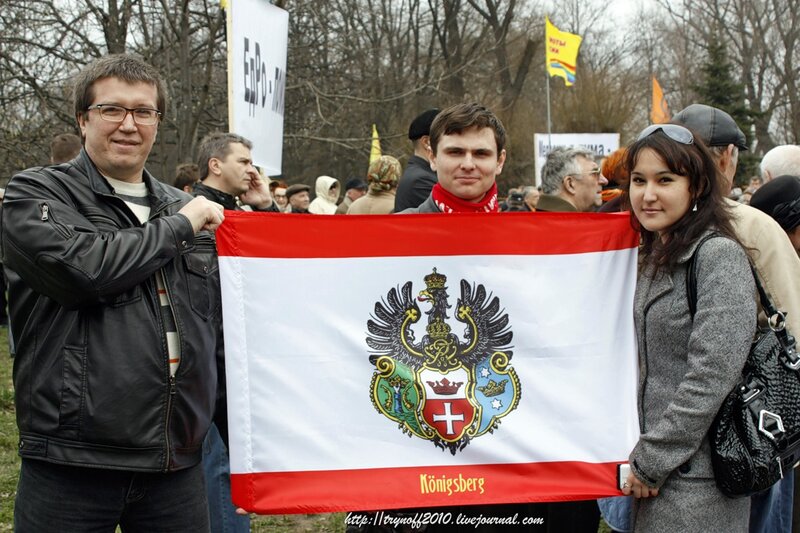
Tuesday, September 20, 2011

Königsberg - the good, Kaliningrad - the bad and the ugly.

Baltic Republican Party states, that Mikhail Kalinin is a children killer, the murderer of thousands of innocent Soviet citizens and an international criminal. It is a moral turpitude of Kremlin and local authorities, that Königsberg and our region still bearing the name of murderer of children .
The city of Königsberg was renamed to Kaliningrad in 1946 after the death of Chairman of the Praesidium of the Supreme Soviet of the USSR Mikhail Kalinin, one of the original Bolsheviks.
Who was actually Mr. Kalinin?

Kalinin was a factional ally of Stalin during the bitter struggle for power which erupted following the death of Lenin in 1924. Kalinin was one of comparatively few members of Stalin's inner circle springing from peasant origins. Kalinin kept a low profile during the Great Purge, he remained submissive to Stalin.
Kalinin's own wife Katarina Loorberg was arrested by the NKVD on 25 October 1938. She was forced under torture to confess to "counter-revolutionary Trotskyist activities" and sent to a labour camp ( the Gulag). She was released in 1945, not long before her husband's death. Kalinin has not taken any steps towards her liberation. He betrayed his closest person - his wife.

During his lifetime, three large cities — Tver, Korolyov and Königsberg — were named or renamed in his honour; the last has retained the name Kaliningrad after the fall of the USSR.
Mikhail Kalinin signed the "Law of Spikelets" or "Law of Three Spikelets". The common name came into use because peasants (including children) caught gleaning (hand-collecting the leftovers of grains or 'spikelets') in the collective fields after the harvest, were arrested for "damaging the state grain production". The punishment was 5 to 10 years of prison camp time. It has been estimated that a quarter of a million people were charged by the OGPU and there were more than 200,000 sentences.

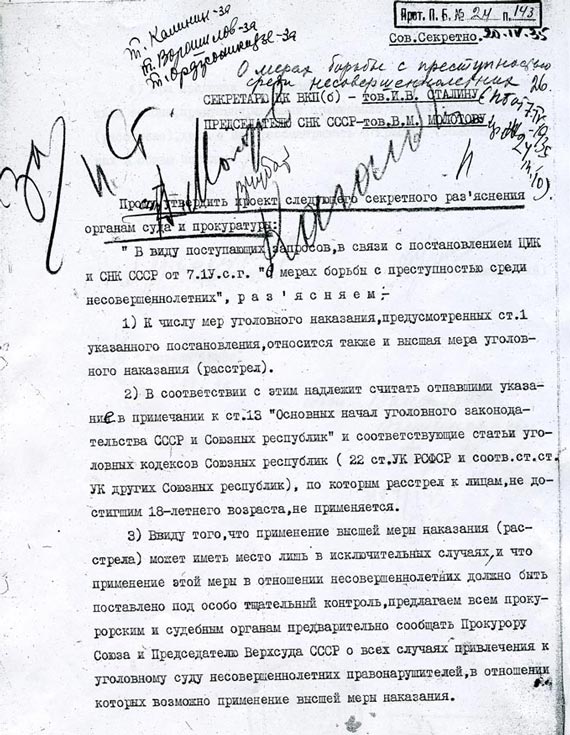
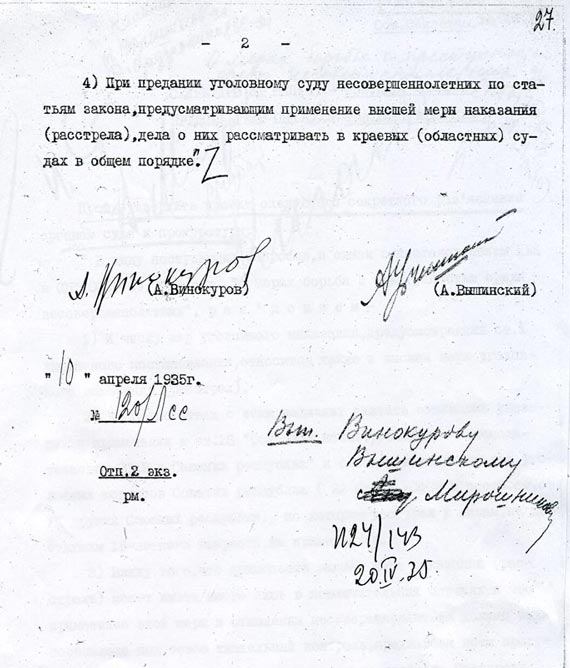
Here are just some of the documents indicating the crimes of Mikhail Kalinin.
A decree about harsher law enforcement.
1 Investigate cases only for 10 days max.
2 By that decree the accused could see his case only 1 day before the trail.
3 The trail in court without hearings of sides.
4 No appeals are allowed.
5 Killing right after the sentence.


The Katyn massacre, was a mass execution of Polish nationals carried out by NKVD, the Soviet secret police, in April and May 1940. This official secret ( not any more) document was approved and signed by the Soviet Politburo, including Mikhail Kalinin. The number of victims is estimated up to 22,000.


Approved by Kalinin mass executions of innocent Soviet citizens. Thousands of such top secret documents in Russian archives. These mass killings were carried out by the security organisations, such as the NKVD ( now FSB), and reached their peak in the Great Purge of 1937-38, when nearly 700,000 were executed by a shot to the base of the skull. Following the demise of the USSR in 1991, many of the killing and burial sites were uncovered. Some of the more notable mass graves include:

Bykivnia - containing an estimated 120,000 - 225,000 corpses

Kurapaty - estimations range from 30,000 to 200,000 bodies found

Butovo - over 20,000 confirmed killed

Sandarmokh - over 9,000 bodies discovered


The Soviet law for execution of children approved by Kalinin. Decree signed by Mikhail Kalinin, which allowed to kill children, later article 12 of Criminal Code of Russia. That Russian law ended only in 1959.
Only in Butovo firing range a location where more than 20,000 political prisoners were shot, including 200 children during the Great Terror of the Soviet Union and thereafter from 1938 to 1953. It is located in the Yuzhnoye Butovo District of Moscow.


Yes, Königsberg went through 12 years of fascism. The Königsberg itself is not guilty of fascism. More then that Königsberg was the anti-fascist city, local Prussian bourgeois and military aristocracy hated Adolf Hitler and his fascistic clowns. At the East Prussian Landtag elections in 1928, the Hitler's party was at the end of the list. In 1932, at the presidential election, Hitler received only 34.5% of Königsberg votes (Social Democrats were leading). After Hitler came to power, many Germans anti-fascists of East Prussia were murdered in concentration camps. The list included, local union leaders, journalists and owners of newspapers, members of political parties (SPD, the Communist Party of Germany, etc.). On 20 July 1944, an attempt was made to assassinate Adolf Hitler, inside his Wolf's Lair field headquarters near Rastenburg, East Prussia. The plot was the culmination of the efforts of several groups in the German Resistance to overthrow the Nazi-led German government. Dozen Königsbergians were involved including Heinrich Graf von Lehndorff-Steinort, Heinrich Graf zu Dohna-Schlobitten, Fritz Goerdeler, Marion Dönhoff etc.

The legendary Soviet spy Richard Sorge, he became an anti-Nazi in Königsberg.

Königsberg - part of Russian History and cultural heritage. Imperial Russian troops occupied eastern Prussia at the beginning of 1758 during the Seven Years' War. On December 31, 1757, Empress Elizabeth I of Russia issued a decree about the incorporation of Königsberg into Russia. On January 24, 1758, the leading burghers of Königsberg submitted to Elizabeth. Five Imperial Russian general-governors administered the city during the war from 1758–62; the Russian army did not abandon the town until 1763. During this time no one tried to rename the city of Königsberg or Tilsit. The same with Tilsit (not Sovetsk), Tilsit written in Russian History as the city of "Treaties of Tilsit".

Baltic Republican Party was one of the first, who proclaimed in 1993, that historical name Königsberg should be returned to the city. We are still do not understand the reason why Kremlin authorities still keeping the name of Kaliningrad for the city of Königsberg. Mikhail Kalinin is a killer of children, the murderer of thousands of innocent Soviet citizens and an international criminal. It is a disgrace to all residents of Königsberg, that our glorious city still bears the name of one of the Kremlin`s murderer.

P.S. While I was writing this article, the Governor Nikolai Tsukanov spoke in Poland about the referendum on the renaming of Kaliningrad. The Baltic Republican Party is fully supports Mr. Nicholay Tsukanov and the head of administration Mr. Felix Lapin. In 2009, Felix Lapin, in an interview to radio "Echo of Moscow" did mention the possibility for returning historical name to the city.

Monday, September 5, 2011

The expulsion of German and Prussian families from East Prussia is a war crime.

The expulsion of German population of East Prussia in Germany, which took place in 1945-1948, was nothing but a war crime in peacetime. The Nazism and Fascism should have been convicted for sure, and many Nazi criminals were punished, but the forced eviction of civilians from their homes in peaceful time is a crime of the 20th century. Total forcibly evicted around 200,000 people. The Potsdam Conference was held at Cecilienhof, the home of Crown Prince Wilhelm Hohenzollern, in Potsdam, occupied Germany, from 16 July to 2 August 1945. Participants were the Soviet Union, the United Kingdom, and the United States. The Potsdam Conference actually legalized the deportation of Germans from the Eastern Europe. From Potsdam Agreement:
V. City of Koenigsberg and the adjacent area. The Conference examined a proposal by the Soviet Government to the effect that pending the final determination of territorial questions at the peace settlement, the section of the western frontier of the Union of Soviet Socialist Republics which is adjacent to the Baltic Sea should pass from a point on the eastern shore of the Bay of Danzig to the east, north of Braunsberg-Goldap, to the meeting point of the frontiers of Lithuania, the Polish Republic and East Prussia. The Conference has agreed in principle to the proposal of the Soviet Government concerning the ultimate transfer to the Soviet Union of the City of Koenigsberg and the area adjacent to it as described above subject to expert examination of the actual frontier. The President of the United States and the British Prime Minister have declared that they will support the proposal of the Conference at the forthcoming peace settlement.
Meanwhile, although a significant number of refugees, the problem of the expulsion of Germans from East Prussia, has remained a taboo subject for a long time. The cohabitation of German and Soviet civilians in East Prussia, which lasted for more than three years 1945-1948, was unique in the history of both nations. Two parallel worlds, each existed by itself, but by force of circumstances, forced to interact with each other, and even cooperate. Due to human nature, between these "worlds" quickly began to appear sincere and deep human connection. One of the main results of cohabitation was overcoming of open hostility of the Soviet people to the Germans. East Prussia (later Kaliningrad region) was the only Russian territory, where it happened so fast. The tendency to bring the two nations together are actively constrained by the policy of the authorities, and then was artificially aborted by the deportation of the German population in 1947-1948 years. Until 1951only a small number of Germans left in the region. Most of them were highly skilled professionals needed for the local economy. The last group (193 people), was sent to the GDR in May 1951.
In those postwar times, even in the Red Army were the voices opposing the bias of society towards the German population. One of these voices was a literary critic Lev Kopelev. When the German-Soviet War broke out in June 1941, he volunteered for the Red Army and used his knowledge of German to serve as a propaganda officer and an interpreter. He entered an East Prussia with the Red Army through the East Prussian Offensive. He sharply criticized the atrocities against the German civilian population. He was arrested in 1945 and sentenced to a ten-year term in the Gulag for fostering bourgeois humanism and for "compassion towards the enemy". Released in 1954, in 1956 he was rehabilitated. The present and future generations should erase the historical mistakes. We all, Russian and Germans paid in full for our mistakes. We're saying to Germans and Prussian families: "Welcome back to Konigsberg". It is a long way for the returning of Germans, but the first steps are taken.

Sunday, August 28, 2011

Only the truth makes us free - official speech at meeting of East Prussia 2011

Erika Steinbach: Nur die Wahrheit macht frei - Festansprache Deutschlandtreffen der Ostpreußen 2011
Erika Steinbach - member of Bundestag from the state of Hesse and the president of "The Federation of Expellees".

Sunday, July 31, 2011

Wednesday, July 20, 2011

Baltic Republican Party vs. Communist Party.


To the Consul of Lithuania in Kaliningrad Mr. VACLAV STANKEVIČ.
We are the members of the Baltic Republican Party, express our regret over the picket by the Communist Party of the Russian Federation, near your consulate in Kaliningrad, on July 18, 2011.
We and many residents of the region, do not share the objectives of the picketing, nor the views of Mr Igor Revin, a MP of the Kaliningrad Oblast (organizer of the picket) and his communistic party members.
We did not take part in the picketing and publicly condemn such unfriendly acts towards you, our dear neighbors and friends.
It should be noted, that the press service of the local FSB office, sent out press releases about the upcoming picketing, to the media of the region. In this regard, such a large coverage of the picket in local and federal press.
Article 170-2 of the Criminal Code of the Republic of Lithuania, is correct. Criminals committed crimes against the Republic of Lithuania and its citizens must be punished. The denial of the documented crimes against the Republic of Lithuania, is also a crime.
Sincerely yours, members of the BRP

Monday, June 13, 2011

Baltic Republican Party on Kremlin TV channel ( NTV).

On Sunday, the TV station "NTV", aired a story about regionalism and separatism in Russian Federation. I said there a few words.

Interestingly, the NTV guys are interviewed about 10 people here (including MPs), interviewed the people's opinion, on the street(20 people), about the future of the region. Me and Sergei Pasko did speak, on camera, with the NTV crew for 5 hours alone. For three days they were filming here and did compress, eventually everything in 1 minute. Well, thanks a lot, to the NTV channel, even for that. Remind you, that every TV&Radio station is under control of the Kremlin. The owners are the people, who affiliated with Kremlin. The owner of NTV channel - the state company "Gazprom".

At the same day, on June 12, our Party member Mr. Igor Kovrigin, held a picketing in Sweden, in the city of Malmo. Igor Kovrigin protested against words, expressed by Prime Minister Vladimir Putin, in denying the fact, that there is should be visa facilitation, for residents of our region with EU. Igor spoke out against the Kremlin's tyranny, where one person administers the fate of a million people. The picketing, also was a part of international political action "Russia - Yes! Putin - no!". The action took place, in cities across the Russia, Latvia, Great Britain, USA, Sweden and Finland.
I want to add, that Russia never had a visa equality, there is NO equality now and never will be. Mr. Vladimir Putin is well aware of it, but puts the citizens of the country into the delusion.
If someone does not know, I will remind you.
Visa exemptions have the following regions of Russia:
1 North-western region of Russia with Finland (EU country).
2 Part of the southern republics of the Russian Federation with Georgia.
3 Far East of Russia with China.
4 Some areas of Chukotka with USA ( Alaska).
5 Murmansk region with Norway.
6 Kuril islands with Japan.
All other regions of Russia obtain visas in these countries on a common basis. Сould you please, Mr.Putin point us out, where is visa equality in Russia? Does your words, just a cheap populism and hypocrisy?

Thursday, June 2, 2011

The Baltic Republican Party in Germany.


On the 28-th and 29-th of May, took place a meeting of former residents of East Prussia - "Deutschlandtreffen der Ostpreußen". I was invited, as representative of the Baltic Republican Party and a resident of the region, by German and Prussian friends.

The meeting was held in Germany, in Erfurt, at the building called "Messe". By my estimates, about 10000 people attended that event, people came from all over the world. At on official part of the event, speeches were held by; politician Stefan Grigat, member of Bundestag from the state of Hesse Erika Steinbach (who is also president of "The Federation of Expellees"), and others.

The informal part of the meeting was held in a cordial and friendly atmosphere. As a representative of the Party, I met with many organizations and individuals. We held lively debates about the past, present and future of the region. Baltic Republican Party, strengthening good-neighbourly relations and develops the European connections.
Speech in German by Stephan Grigat.
http://www.odfinfo.de/Div/DT-Erfurt-2011/Rede-Grigat.htm
P.S. There were no Königsberger Klopse on the menu, that`s a pity. :)

Friday, May 20, 2011

Meeting with the Governor Nikolay Tsukanov.

My attitude towards Nikolay Nikolaevich Tsukanov were always positive, from the very beginning, when he supported our political campaign, on simplification of visa regime.
I usually do not visit the meetings with Russian officials. Not interesting to me, no desire to ask questions, because I know the answers. Or perhaps a mutual antipathy, as officials and politicians (to whom I myself barely include here) are different sides, and sometimes enemies. I did not want to go and at this meeting, but then changed my mind, because stated theme "The Future of the Region", was interesting for me.
For me was a great honour to meet and ask a few questions, the VIP. Nikolay Tsukanov is not just a VIP, from my regional views - the President.

The meeting was organized by blogger`s talkclub "AmberKant" and the head of that club Mr. Dmitry Nadrshin ( my friend). I see the fruits of democracy in Russia, VIP comes to the bloggers. The day before the meeting, I asked you, my worldwide readers of my blog, which questions would you like to ask the governor directly. It was very surprising for some of you, since many of you, had no answers from your governments. I get some questions from you, two of them I asked, the governor answered - fair enough. The first question about the monument to Alexander Marinesko in Kaliningrad ( Königsberg) and the controversy of the monument itself, because of the tragedy of "an attack of the century"( as Russians call it) in which was sunk the " Wilhelm Gustloff " (a question of Dr. Wolfgang Kelker from Frankfurt am Main) and the second question on issue of facilitation of visa regime for EU citizens, for Kaliningrad ( Königsberg) region ( a question of Florian, student from Germany).
The meeting was a good one, who wanted to ask sharp questions, did that. I want to wish a success to Nikolay, and especially in lobbying for the visa`s issue at the federal level. For his support of our initiatives on visa subject, I shook his hand.
My questions and the answers of Nikolay Tsukanov, in Russian - starting at 44.00 and finishing at 50.16. I will translate for you his answers on those two questions, but later.

After the meeting, I came to the Governor and asked him, about the possibility for him, to answer the questions from the worldwide audience. He was positive about it, so hopefully, later he will answer your questions. Anyway, your questions for him, you could start asking right now.

Friday, April 22, 2011

Immanuel Kant and Baltic Republican Party.


Today is a birthday of Immanuel Kant. Our Baltic Republican Party, put a flowers to the grave of great world philosopher. It is our tradition. We raised the flag of our banned Party. Long live Königsberg!

Strangely enough a few days we were filmed, by one of the Kremlin TV station. We are not allowed even in the local press and TV by the Kremlin censorship, but now we are appearing on national level.

Monday, April 18, 2011

For Königsberg!

That was yesterday at political rally in Kaliningrad. I raised the flag of Königsberg.

Friday, April 15, 2011

Königsberg Is Dead


Language of the film - German.
This really provides with a refreshing point of view on the restless Königsberg/Kaliningrad-issue. Obviously made by people emotionally unburdened by any memories from before 1945, it lacks any nostalgia for the times that once were.

In this respect 'Königsberg is dead' is at a lightyears' distance from the usual documentary about former East Prussia. It's quite good, though, and certainly made with great historical precision.

Most valuable is its documentation about the times after 1945. Extending these right to the present day, it reveals how the Kaliningraders have to deal with a strong indentity-problem. They are Russian, but their country doesn't look Russian; they live in today's Russia, but are constantly reminded of their country's German past; for their cultural interests they look westwards, while their country is tied up eastwards; They want to make a proper life, while Moscow hardly cares about them.
Part 2
http://www.youtube.com/watch?v=Snj84WdSTRo
Part 3
http://www.youtube.com/watch?v=gVzTh7pFouo
Part 4
http://www.youtube.com/watch?v=VCoVOsfLBXI

Monday, April 11, 2011

Elder Blossom / Holunderblüte


Stories from the Kaliningrad region and its inhabitants: with the calamity of unemployment and the ravages of alcohol, many children are left to their own devices, in landscapes that are retuning to the wild. Games, dreams, solidarity, and the fierce will to live defy a forsaken world.
The film tells the story of the East Prussian landscape and its inhabitants. A region steeped in history. At one time Germans, Poles, Lithuanians and Jews lived here alongside and with one another. After World War II and the expulsion of Germans by the decision of USSR, USA and UK at the Potsdam Conference, the Prussian province turned into a Russian exclave, more important geostrategically than economically. An absurd rudiment of political power games.
The film dedicated to a generation, born in the 90's, and familiar with the Soviet Union and East Prussia only from school books. Their present is a different one. Parents and Grandparents who were resettled to where they are now have never really felt at home. In the meantime they have hopelessly succumb to unemployment and alcohol. Their children can only rely on themselves.
Part 2
http://www.youtube.com/watch?v=531SsCdoq3k
Part 3
http://www.youtube.com/watch?v=DgHL7kiVUnE
Part 4
http://www.youtube.com/watch?v=uT6gC3rwGTI

Part 5
http://www.youtube.com/watch?v=AEJXn5mkTdo

Friday, March 11, 2011

The Kaliningrad oblast - an illegitimate region.

The so-called Kaliningrad oblast and the so-called authorities of that pseudo-formation are illegitimate.The status of the region for sure questionable in the world, but not even that, the Kaliningrad oblast illegitimate by Russian law.
Citizens of the Russian Federation, on 12 December 1993 adopted the basic law of their life - the Constitution. The Constitution begins: "We, the multinational people of the Russian Federation ...".
Third article of the Constitution states - "The bearer of sovereignty and the only source of power in the Russian Federation shall be its multinational people. No one may usurp power in the Russian Federation. Seizure of power or usurping state authority shall be prosecuted by federal law". In the sense, that power can not be seized by anybody without a decision by the people.
The Kaliningrad Region, being before an ordinary administrative-territorial unit of the USSR, suddenly became the subject of the Russian Federation, and like the rest of the subjects became eligible for state attributes of power: the status, the adoption of the Basic Law, the definition of a system of legislative and executive power (Article 77 of Constitution) .
Let's talk about two main authorities of a state power: the Kaliningrad Regional Duma ( the Parliament) and the Governor.
They form a system. The question arises. Who has defined that system?
The right to define a system of public authorities in the Kaliningrad region belongs only to people who living on its territory. What do we have then?
The Basic Law of the Kaliningrad region accepted on 28 December 1995 and is called the Charter. It begins with the mysterious words "The Duma of Kaliningrad Oblast ...", in Article 17 of Charter recorded more mystery, that Duma "is a permanent supreme and legislative authority of the Kaliningrad region". There is not even a word about the will of the people either in the preamble or the text of the Charter. So, where did the Duma appeared from, who expressed his will to empower its government? It is unknown.
In the same Charter, they named the chief executive of the region - the Governor. Self-proclaimed Duma has unlawfully presented to us with a second self-proclaimed branch of power. That's how we live, without democracy, driven by impostors and yes we even spend on their maintenance as much as they want.
Now let's talk about the status of the region.
Russia's status is enshrined in the first article of the Constitution: "The Russian Federation - Russia is a democratic federal law-bound State with a republican form of government." The world community considered Constitution as legitimate, since the words beginning "... we the people" and it was accepted on a referendum.
Identification of the form of statehood as Federation, entails a number of legally binding consequences. So, only the state formations can be members (subjects) of federation . They could be called republics, areas, "oblasts", but firstly they must be subjects of the public law. Gaining such law, according to article 3 of the Constitution, possible only by the highest expression of the will of the people living in particular region and differ from other regions. That is a public referendum, the will of the people. No public referendum held on the territory of the so-called "Kaliningrad oblast", and consequently pseudo-formation is illegitimate, and power seized by by thieves - impostors.
In the Russian Federation only 8 state subjects (Tatarstan, Bashkortostan, Sakha-Yakutia and Kalmykia and others, in time till December, 12th 1993 held referendum about the status). The remaining 80 regions have not yet become a state subjects, and those regions can not be legitimate. They are simply territories of Russia where citizens of Russia live.
The right of statehood status is eligible by all regions of Russia. This right is written in Article 66 part 1 of the Constitution of the Russian Federation.

Eine Liebe in Königsberg

Even if you don´t speak German ( I do not speak, just a few words) the pictures are still powerful.
A man´s mother died and her last will is to have her ashes distributed in her beloved hometown Königsberg.
Her son, who was never interested in this story, travels to Königsberg to fulfil his mother´s last wish.
He finds out, that his father was a Russian officer, who was in love with his mother, who was a nurse at a hospital, but their love was not accepted in the Soviet Union.
He gradually finds out the truth and finds a half sister and his father.

Part 2
http://www.youtube.com/watch?v=mQJGe6v5WYY&feature=related
Part 3
http://www.youtube.com/watch?v=qul_DKk2Hf8&feature=related
Part 4
http://www.youtube.com/watch?v=9U9j2Mje60c&feature=related
Part 5
http://www.youtube.com/watch?v=HiKsBIbHg64&feature=related
Part 6
http://www.youtube.com/watch?v=Kn_TLLMfWF4&feature=related