Erika Steinbach: Nur die Wahrheit macht frei - Festansprache Deutschlandtreffen der Ostpreußen 2011
Erika Steinbach - member of Bundestag from the state of Hesse and the president of "The Federation of Expellees".
Sunday, August 28, 2011

Sunday, July 31, 2011
Wednesday, July 20, 2011
Baltic Republican Party vs. Communist Party.

To the Consul of Lithuania in Kaliningrad Mr. VACLAV STANKEVIČ.
We are the members of the Baltic Republican Party, express our regret over the picket by the Communist Party of the Russian Federation, near your consulate in Kaliningrad, on July 18, 2011.
We and many residents of the region, do not share the objectives of the picketing, nor the views of Mr Igor Revin, a MP of the Kaliningrad Oblast (organizer of the picket) and his communistic party members.
We did not take part in the picketing and publicly condemn such unfriendly acts towards you, our dear neighbors and friends.
It should be noted, that the press service of the local FSB office, sent out press releases about the upcoming picketing, to the media of the region. In this regard, such a large coverage of the picket in local and federal press.
Article 170-2 of the Criminal Code of the Republic of Lithuania, is correct. Criminals committed crimes against the Republic of Lithuania and its citizens must be punished. The denial of the documented crimes against the Republic of Lithuania, is also a crime.
Sincerely yours, members of the BRP
Monday, June 13, 2011
Baltic Republican Party on Kremlin TV channel ( NTV).
On Sunday, the TV station "NTV", aired a story about regionalism and separatism in Russian Federation. I said there a few words.
Interestingly, the NTV guys are interviewed about 10 people here (including MPs), interviewed the people's opinion, on the street(20 people), about the future of the region. Me and Sergei Pasko did speak, on camera, with the NTV crew for 5 hours alone. For three days they were filming here and did compress, eventually everything in 1 minute. Well, thanks a lot, to the NTV channel, even for that. Remind you, that every TV&Radio station is under control of the Kremlin. The owners are the people, who affiliated with Kremlin. The owner of NTV channel - the state company "Gazprom".

At the same day, on June 12, our Party member Mr. Igor Kovrigin, held a picketing in Sweden, in the city of Malmo. Igor Kovrigin protested against words, expressed by Prime Minister Vladimir Putin, in denying the fact, that there is should be visa facilitation, for residents of our region with EU. Igor spoke out against the Kremlin's tyranny, where one person administers the fate of a million people. The picketing, also was a part of international political action "Russia - Yes! Putin - no!". The action took place, in cities across the Russia, Latvia, Great Britain, USA, Sweden and Finland.
I want to add, that Russia never had a visa equality, there is NO equality now and never will be. Mr. Vladimir Putin is well aware of it, but puts the citizens of the country into the delusion.
If someone does not know, I will remind you.
Visa exemptions have the following regions of Russia:
1 North-western region of Russia with Finland (EU country).
2 Part of the southern republics of the Russian Federation with Georgia.
3 Far East of Russia with China.
4 Some areas of Chukotka with USA ( Alaska).
5 Murmansk region with Norway.
6 Kuril islands with Japan.
All other regions of Russia obtain visas in these countries on a common basis. Сould you please, Mr.Putin point us out, where is visa equality in Russia? Does your words, just a cheap populism and hypocrisy?
Interestingly, the NTV guys are interviewed about 10 people here (including MPs), interviewed the people's opinion, on the street(20 people), about the future of the region. Me and Sergei Pasko did speak, on camera, with the NTV crew for 5 hours alone. For three days they were filming here and did compress, eventually everything in 1 minute. Well, thanks a lot, to the NTV channel, even for that. Remind you, that every TV&Radio station is under control of the Kremlin. The owners are the people, who affiliated with Kremlin. The owner of NTV channel - the state company "Gazprom".
At the same day, on June 12, our Party member Mr. Igor Kovrigin, held a picketing in Sweden, in the city of Malmo. Igor Kovrigin protested against words, expressed by Prime Minister Vladimir Putin, in denying the fact, that there is should be visa facilitation, for residents of our region with EU. Igor spoke out against the Kremlin's tyranny, where one person administers the fate of a million people. The picketing, also was a part of international political action "Russia - Yes! Putin - no!". The action took place, in cities across the Russia, Latvia, Great Britain, USA, Sweden and Finland.
I want to add, that Russia never had a visa equality, there is NO equality now and never will be. Mr. Vladimir Putin is well aware of it, but puts the citizens of the country into the delusion.
If someone does not know, I will remind you.
Visa exemptions have the following regions of Russia:
1 North-western region of Russia with Finland (EU country).
2 Part of the southern republics of the Russian Federation with Georgia.
3 Far East of Russia with China.
4 Some areas of Chukotka with USA ( Alaska).
5 Murmansk region with Norway.
6 Kuril islands with Japan.
All other regions of Russia obtain visas in these countries on a common basis. Сould you please, Mr.Putin point us out, where is visa equality in Russia? Does your words, just a cheap populism and hypocrisy?
Thursday, June 2, 2011
The Baltic Republican Party in Germany.

On the 28-th and 29-th of May, took place a meeting of former residents of East Prussia - "Deutschlandtreffen der Ostpreußen". I was invited, as representative of the Baltic Republican Party and a resident of the region, by German and Prussian friends.

The meeting was held in Germany, in Erfurt, at the building called "Messe". By my estimates, about 10000 people attended that event, people came from all over the world. At on official part of the event, speeches were held by; politician Stefan Grigat, member of Bundestag from the state of Hesse Erika Steinbach (who is also president of "The Federation of Expellees"), and others.
The informal part of the meeting was held in a cordial and friendly atmosphere. As a representative of the Party, I met with many organizations and individuals. We held lively debates about the past, present and future of the region. Baltic Republican Party, strengthening good-neighbourly relations and develops the European connections.
Speech in German by Stephan Grigat.
http://www.odfinfo.de/Div/DT-Erfurt-2011/Rede-Grigat.htm
P.S. There were no Königsberger Klopse on the menu, that`s a pity. :)

Friday, May 20, 2011
Meeting with the Governor Nikolay Tsukanov.
My attitude towards Nikolay Nikolaevich Tsukanov were always positive, from the very beginning, when he supported our political campaign, on simplification of visa regime.
I usually do not visit the meetings with Russian officials. Not interesting to me, no desire to ask questions, because I know the answers. Or perhaps a mutual antipathy, as officials and politicians (to whom I myself barely include here) are different sides, and sometimes enemies. I did not want to go and at this meeting, but then changed my mind, because stated theme "The Future of the Region", was interesting for me.
For me was a great honour to meet and ask a few questions, the VIP. Nikolay Tsukanov is not just a VIP, from my regional views - the President.

The meeting was organized by blogger`s talkclub "AmberKant" and the head of that club Mr. Dmitry Nadrshin ( my friend). I see the fruits of democracy in Russia, VIP comes to the bloggers. The day before the meeting, I asked you, my worldwide readers of my blog, which questions would you like to ask the governor directly. It was very surprising for some of you, since many of you, had no answers from your governments. I get some questions from you, two of them I asked, the governor answered - fair enough. The first question about the monument to Alexander Marinesko in Kaliningrad ( Königsberg) and the controversy of the monument itself, because of the tragedy of "an attack of the century"( as Russians call it) in which was sunk the " Wilhelm Gustloff " (a question of Dr. Wolfgang Kelker from Frankfurt am Main) and the second question on issue of facilitation of visa regime for EU citizens, for Kaliningrad ( Königsberg) region ( a question of Florian, student from Germany).
The meeting was a good one, who wanted to ask sharp questions, did that. I want to wish a success to Nikolay, and especially in lobbying for the visa`s issue at the federal level. For his support of our initiatives on visa subject, I shook his hand.
My questions and the answers of Nikolay Tsukanov, in Russian - starting at 44.00 and finishing at 50.16. I will translate for you his answers on those two questions, but later.
After the meeting, I came to the Governor and asked him, about the possibility for him, to answer the questions from the worldwide audience. He was positive about it, so hopefully, later he will answer your questions. Anyway, your questions for him, you could start asking right now.
I usually do not visit the meetings with Russian officials. Not interesting to me, no desire to ask questions, because I know the answers. Or perhaps a mutual antipathy, as officials and politicians (to whom I myself barely include here) are different sides, and sometimes enemies. I did not want to go and at this meeting, but then changed my mind, because stated theme "The Future of the Region", was interesting for me.
For me was a great honour to meet and ask a few questions, the VIP. Nikolay Tsukanov is not just a VIP, from my regional views - the President.
The meeting was organized by blogger`s talkclub "AmberKant" and the head of that club Mr. Dmitry Nadrshin ( my friend). I see the fruits of democracy in Russia, VIP comes to the bloggers. The day before the meeting, I asked you, my worldwide readers of my blog, which questions would you like to ask the governor directly. It was very surprising for some of you, since many of you, had no answers from your governments. I get some questions from you, two of them I asked, the governor answered - fair enough. The first question about the monument to Alexander Marinesko in Kaliningrad ( Königsberg) and the controversy of the monument itself, because of the tragedy of "an attack of the century"( as Russians call it) in which was sunk the " Wilhelm Gustloff " (a question of Dr. Wolfgang Kelker from Frankfurt am Main) and the second question on issue of facilitation of visa regime for EU citizens, for Kaliningrad ( Königsberg) region ( a question of Florian, student from Germany).
The meeting was a good one, who wanted to ask sharp questions, did that. I want to wish a success to Nikolay, and especially in lobbying for the visa`s issue at the federal level. For his support of our initiatives on visa subject, I shook his hand.
My questions and the answers of Nikolay Tsukanov, in Russian - starting at 44.00 and finishing at 50.16. I will translate for you his answers on those two questions, but later.
After the meeting, I came to the Governor and asked him, about the possibility for him, to answer the questions from the worldwide audience. He was positive about it, so hopefully, later he will answer your questions. Anyway, your questions for him, you could start asking right now.
Friday, April 22, 2011
Immanuel Kant and Baltic Republican Party.

Today is a birthday of Immanuel Kant. Our Baltic Republican Party, put a flowers to the grave of great world philosopher. It is our tradition. We raised the flag of our banned Party. Long live Königsberg!

Strangely enough a few days we were filmed, by one of the Kremlin TV station. We are not allowed even in the local press and TV by the Kremlin censorship, but now we are appearing on national level.
Tuesday, April 19, 2011


Monday, April 18, 2011
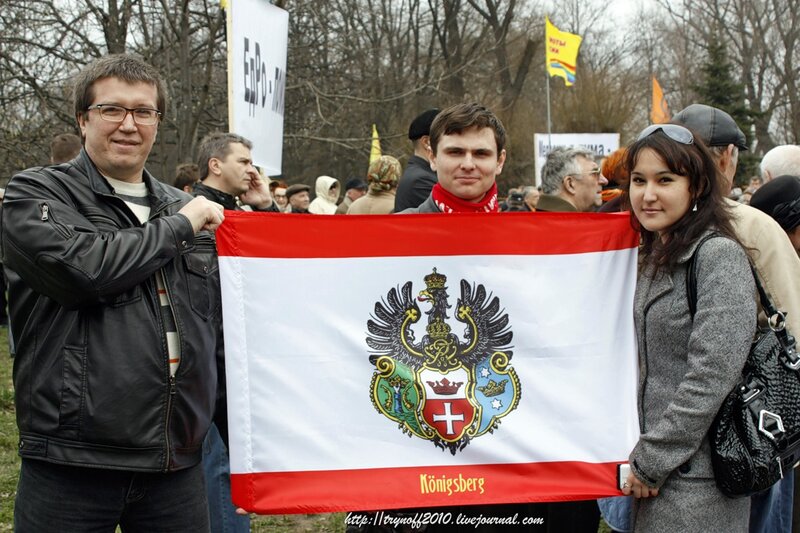
For Königsberg!
That was yesterday at political rally in Kaliningrad. I raised the flag of Königsberg.

Friday, April 15, 2011
Königsberg Is Dead
Language of the film - German.
This really provides with a refreshing point of view on the restless Königsberg/Kaliningrad-issue. Obviously made by people emotionally unburdened by any memories from before 1945, it lacks any nostalgia for the times that once were.
In this respect 'Königsberg is dead' is at a lightyears' distance from the usual documentary about former East Prussia. It's quite good, though, and certainly made with great historical precision.
Most valuable is its documentation about the times after 1945. Extending these right to the present day, it reveals how the Kaliningraders have to deal with a strong indentity-problem. They are Russian, but their country doesn't look Russian; they live in today's Russia, but are constantly reminded of their country's German past; for their cultural interests they look westwards, while their country is tied up eastwards; They want to make a proper life, while Moscow hardly cares about them.
Part 2
http://www.youtube.com/watch?v=Snj84WdSTRo
Part 3
http://www.youtube.com/watch?v=gVzTh7pFouo
Part 4
http://www.youtube.com/watch?v=VCoVOsfLBXI
Monday, April 11, 2011
Elder Blossom / Holunderblüte
Stories from the Kaliningrad region and its inhabitants: with the calamity of unemployment and the ravages of alcohol, many children are left to their own devices, in landscapes that are retuning to the wild. Games, dreams, solidarity, and the fierce will to live defy a forsaken world.
The film tells the story of the East Prussian landscape and its inhabitants. A region steeped in history. At one time Germans, Poles, Lithuanians and Jews lived here alongside and with one another. After World War II and the expulsion of Germans by the decision of USSR, USA and UK at the Potsdam Conference, the Prussian province turned into a Russian exclave, more important geostrategically than economically. An absurd rudiment of political power games.
The film dedicated to a generation, born in the 90's, and familiar with the Soviet Union and East Prussia only from school books. Their present is a different one. Parents and Grandparents who were resettled to where they are now have never really felt at home. In the meantime they have hopelessly succumb to unemployment and alcohol. Their children can only rely on themselves.
Part 2
http://www.youtube.com/watch?v=531SsCdoq3k
Part 3
http://www.youtube.com/watch?v=DgHL7kiVUnE
Part 4
http://www.youtube.com/watch?v=uT6gC3rwGTI
Part 5
http://www.youtube.com/watch?v=AEJXn5mkTdo
Friday, March 11, 2011
The Kaliningrad oblast - an illegitimate region.
The so-called Kaliningrad oblast and the so-called authorities of that pseudo-formation are illegitimate.The status of the region for sure questionable in the world, but not even that, the Kaliningrad oblast illegitimate by Russian law.
Citizens of the Russian Federation, on 12 December 1993 adopted the basic law of their life - the Constitution. The Constitution begins: "We, the multinational people of the Russian Federation ...".
Third article of the Constitution states - "The bearer of sovereignty and the only source of power in the Russian Federation shall be its multinational people. No one may usurp power in the Russian Federation. Seizure of power or usurping state authority shall be prosecuted by federal law". In the sense, that power can not be seized by anybody without a decision by the people.
The Kaliningrad Region, being before an ordinary administrative-territorial unit of the USSR, suddenly became the subject of the Russian Federation, and like the rest of the subjects became eligible for state attributes of power: the status, the adoption of the Basic Law, the definition of a system of legislative and executive power (Article 77 of Constitution) .
Let's talk about two main authorities of a state power: the Kaliningrad Regional Duma ( the Parliament) and the Governor.
They form a system. The question arises. Who has defined that system?
The right to define a system of public authorities in the Kaliningrad region belongs only to people who living on its territory. What do we have then?
The Basic Law of the Kaliningrad region accepted on 28 December 1995 and is called the Charter. It begins with the mysterious words "The Duma of Kaliningrad Oblast ...", in Article 17 of Charter recorded more mystery, that Duma "is a permanent supreme and legislative authority of the Kaliningrad region". There is not even a word about the will of the people either in the preamble or the text of the Charter. So, where did the Duma appeared from, who expressed his will to empower its government? It is unknown.
In the same Charter, they named the chief executive of the region - the Governor. Self-proclaimed Duma has unlawfully presented to us with a second self-proclaimed branch of power. That's how we live, without democracy, driven by impostors and yes we even spend on their maintenance as much as they want.
Now let's talk about the status of the region.
Russia's status is enshrined in the first article of the Constitution: "The Russian Federation - Russia is a democratic federal law-bound State with a republican form of government." The world community considered Constitution as legitimate, since the words beginning "... we the people" and it was accepted on a referendum.
Identification of the form of statehood as Federation, entails a number of legally binding consequences. So, only the state formations can be members (subjects) of federation . They could be called republics, areas, "oblasts", but firstly they must be subjects of the public law. Gaining such law, according to article 3 of the Constitution, possible only by the highest expression of the will of the people living in particular region and differ from other regions. That is a public referendum, the will of the people. No public referendum held on the territory of the so-called "Kaliningrad oblast", and consequently pseudo-formation is illegitimate, and power seized by by thieves - impostors.
In the Russian Federation only 8 state subjects (Tatarstan, Bashkortostan, Sakha-Yakutia and Kalmykia and others, in time till December, 12th 1993 held referendum about the status). The remaining 80 regions have not yet become a state subjects, and those regions can not be legitimate. They are simply territories of Russia where citizens of Russia live.
The right of statehood status is eligible by all regions of Russia. This right is written in Article 66 part 1 of the Constitution of the Russian Federation.
Citizens of the Russian Federation, on 12 December 1993 adopted the basic law of their life - the Constitution. The Constitution begins: "We, the multinational people of the Russian Federation ...".
Third article of the Constitution states - "The bearer of sovereignty and the only source of power in the Russian Federation shall be its multinational people. No one may usurp power in the Russian Federation. Seizure of power or usurping state authority shall be prosecuted by federal law". In the sense, that power can not be seized by anybody without a decision by the people.
The Kaliningrad Region, being before an ordinary administrative-territorial unit of the USSR, suddenly became the subject of the Russian Federation, and like the rest of the subjects became eligible for state attributes of power: the status, the adoption of the Basic Law, the definition of a system of legislative and executive power (Article 77 of Constitution) .
Let's talk about two main authorities of a state power: the Kaliningrad Regional Duma ( the Parliament) and the Governor.
They form a system. The question arises. Who has defined that system?
The right to define a system of public authorities in the Kaliningrad region belongs only to people who living on its territory. What do we have then?
The Basic Law of the Kaliningrad region accepted on 28 December 1995 and is called the Charter. It begins with the mysterious words "The Duma of Kaliningrad Oblast ...", in Article 17 of Charter recorded more mystery, that Duma "is a permanent supreme and legislative authority of the Kaliningrad region". There is not even a word about the will of the people either in the preamble or the text of the Charter. So, where did the Duma appeared from, who expressed his will to empower its government? It is unknown.
In the same Charter, they named the chief executive of the region - the Governor. Self-proclaimed Duma has unlawfully presented to us with a second self-proclaimed branch of power. That's how we live, without democracy, driven by impostors and yes we even spend on their maintenance as much as they want.
Now let's talk about the status of the region.
Russia's status is enshrined in the first article of the Constitution: "The Russian Federation - Russia is a democratic federal law-bound State with a republican form of government." The world community considered Constitution as legitimate, since the words beginning "... we the people" and it was accepted on a referendum.
Identification of the form of statehood as Federation, entails a number of legally binding consequences. So, only the state formations can be members (subjects) of federation . They could be called republics, areas, "oblasts", but firstly they must be subjects of the public law. Gaining such law, according to article 3 of the Constitution, possible only by the highest expression of the will of the people living in particular region and differ from other regions. That is a public referendum, the will of the people. No public referendum held on the territory of the so-called "Kaliningrad oblast", and consequently pseudo-formation is illegitimate, and power seized by by thieves - impostors.
In the Russian Federation only 8 state subjects (Tatarstan, Bashkortostan, Sakha-Yakutia and Kalmykia and others, in time till December, 12th 1993 held referendum about the status). The remaining 80 regions have not yet become a state subjects, and those regions can not be legitimate. They are simply territories of Russia where citizens of Russia live.
The right of statehood status is eligible by all regions of Russia. This right is written in Article 66 part 1 of the Constitution of the Russian Federation.
Eine Liebe in Königsberg
Even if you don´t speak German ( I do not speak, just a few words) the pictures are still powerful.
A man´s mother died and her last will is to have her ashes distributed in her beloved hometown Königsberg.
Her son, who was never interested in this story, travels to Königsberg to fulfil his mother´s last wish.
He finds out, that his father was a Russian officer, who was in love with his mother, who was a nurse at a hospital, but their love was not accepted in the Soviet Union.
He gradually finds out the truth and finds a half sister and his father.Part 2
http://www.youtube.com/watch?v=mQJGe6v5WYY&feature=related
Part 3
http://www.youtube.com/watch?v=qul_DKk2Hf8&feature=related
Part 4
http://www.youtube.com/watch?v=9U9j2Mje60c&feature=related
Part 5
http://www.youtube.com/watch?v=HiKsBIbHg64&feature=related
Part 6
http://www.youtube.com/watch?v=Kn_TLLMfWF4&feature=related
Friday, February 11, 2011
You shall not covet anything that belongs to your neighbor.
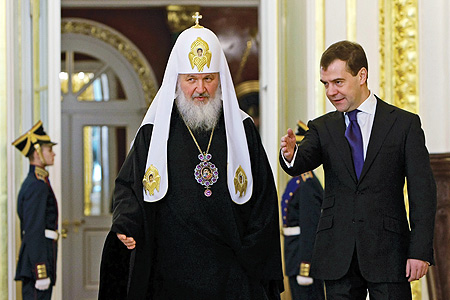
 Despite criticism that it will revisit yet more thorny tangles from Russia’s past, Parliament has passed a law to restore to religious organizations property seized by the state in Soviet times.
Under the law, the federal, regional and municipal authorities have two years to hand over property after a decision is made on a claim by the church, either for rent-free use or in a full transfer of ownership.
While the law addresses religious property generally, it is seen as broadly favouring the Russian Orthodox Church, the largest religious organization in the nation, though all groups had property taken by the Communists.
The new law dictates that government bodies must post all property claims and decisions on Web sites. Claims can be disputed in court and legal challenges are expected. The concept of former church real estate extends not only to buildings that were used for worship, but also to church-run hospitals, schools and residential buildings.
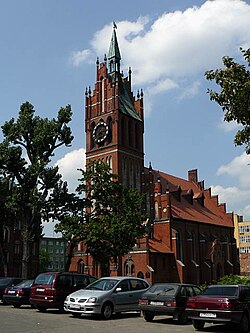
In Kaliningrad, the former German Königsberg that ended up in Soviet hands after World War II, questions of church property are especially complex. The regional legislature voted to transfer more than a dozen former Catholic and Lutheran churches, cathedrals and Teutonic castles to the Russian Orthodox Church, which says Orthodox believers there are underserved.
 Moscow’s relations with the Vatican had been improving, but Archbishop Paolo Pezzi, whose diocese oversees Moscow and Kaliningrad, said that the region’s legislators were “profoundly mistaken” in their effort to hand over the neo-Gothic Church of the Holy Family to the Russian Orthodox rather than the Roman Catholic Church. The church is now used by the Kaliningrad Philharmonic.
The debate has reached across borders. After protests from the government of neighboring Lithuania, the Kaliningrad region is reconsidering its decision to include in the transfer list a Lutheran church that is the burial site of Kristijonas Donelaitis, a Lithuanian pastor and poet.
Properties in Kaliningrad region, that handed over, by the local government, to the Russian Orthodox Church for free.
1 Church of the Holy Family
http://en.wikipedia.org/wiki/Church_of_the_Holy_Family,_Kaliningrad
2 Arnau Church ( German cultural organisation paid 320000 Euro to restore that Church)
http://en.wikipedia.org/wiki/Arnau_Church
3 Königin-Luise-Gedächtniskirche
http://de.wikipedia.org/wiki/K%C3%B6nigin-Luise-Ged%C3%A4chtniskirche_%28Kaliningrad%29
4 Waldau Castle
http://www.tacis.zamkigotyckie.org.pl/waldau-ang.htm
5 Neuhausen Castle
http://www.tacis.zamkigotyckie.org.pl/neuhausen-ang.htm
6 Taplacken Castle
http://www.tacis.zamkigotyckie.org.pl/talpaki-ang.htm
7 Ragnit Castle
http://www.tacis.zamkigotyckie.org.pl/ragneta-ang.htm
8 Labiau Castle
http://www.tacis.zamkigotyckie.org.pl/labiau-ang.htm
9 Gergdauen Castle
http://www.tacis.zamkigotyckie.org.pl/gierdawy-ang.htm
10 Insterburg Castle
http://www.tacis.zamkigotyckie.org.pl/wystruc-ang.htm
And about 15 or so other properties.

 My friends and I rallied against the transfer of cathedrals and castles to the Russian Orthodox Church. But usually we did end up in the police stations through the court procedures and fines. We signed up the petition to the president of Russia, local intelligentsia did back us up, but unfortunately local and federal authorities do not wish to hear us.
Tuesday, February 1, 2011
Mit offenen Karten - Kaliningrad - Eine Deutsche Geschichte
Mit offenen Karten - Kaliningrad - Eine deutsche... megaman7de
Kaliningrad - Eine Russische Insel In Der Eu
Subscribe to:
Posts (Atom)