Wednesday, July 7, 2010

Königsberg Castle ( Königsberger Schloss) must be rebuilt.


For years Kaliningrad has been allowed to decay as a forgotten Russian enclave surrounded by Europe. But now a movement is afoot to rebuild the city center. The castle too may soon dominate the skyline once again.
The city center of Kaliningrad is not a pretty site.
Shoddy concrete housing blocks constructed by the late communist regime stand next to rusted water fountains and apartment blocks from the Third Reich. A 20-story Communist Party fortress ( the "House of the Soviets") rises up in the center. The building is a ruin.
It's not uncommon for elderly East Prussians ( having arrived in a tour boat in the nearby port of Pillau) to break into tears when they see to what architectural depths their city of birth has sunk to. The destruction visited on the former pearl on the Pregel River by the bombs of World War II was immense - matched by hardly any other European city. Indeed, Kaliningrad, once known by its German name Königsberg, became a symbol not just of loss, but also of the destruction of homeland.
Some 30 divisions and two air fleets of the Red Army attacked the surrounded city during the final battle in April 1945. They fired at the city from thousands of barrels for days, without interruption.
It's time to turn the tide.
No one here wants to run from the city's Prussian German legacy. On the contrary. To restore a sense of urbanity to the ravaged city center ( further wrecked by the Soviets) is to go retro.
The cathedral, which was damaged during the war, has already been rebuilt. The "Fishermen`s Village" - a group of old half-timbered houses and 18th century-style warehouses complete with pinnacled roofs - is currently taking shape right next door, on the banks of the Pregel.
But the city is presently the site of another, far more ambitious project - that of rebuilding its castle. The defensive fortress was built by the Teutonic Order in 1255 as a jumping off point for crusaders heading east - a military stronghold in the midst of a pagan wilderness, built on the ruins of the freshly conquered Baltic fortress Twangste.
The old Prussian center was considered a "hornet's nest of militarism and fascism" in the jargon of the communist rulers. In 1969, then party leader Leonid Brezhnev had the still impressive castle ruins blown up and the rubble cleared away with bulldozers, right down to the foundations.
That kind of animosity is hardly to be found in Kaliningrad today. An isolated region, northern East Prussia led an impoverished and shadowy existence in the Soviet empire for decades, but now a fresh wind is blowing. Petro-billionaires and oligarchs from Moscow have discovered the region for themselves and they're bringing plenty of money, much of it of dubious origin, into the area.
Economic growth could be one reason. For the third year in a row, the enclave by the Baltic Sea has seen GDP jump by at least 10 percent. Bars, restaurants and hotels are springing up out of the ground and the city now has the second highest concentration of cars in the country. The old Amber Coast has become Russia's new place in the sun.
Russian prime minister Vladimir Putin likes the idea of bringing back the Prussian fortress. On a visit to the region, he promised the equivalent of $50 million from the state treasury. Putin, of course, also has an interest in a resurgence of Kaliningrad. His family is currently building a villa in the area, on the Courland Spit which separates the nearby Courland Lagoon from the Baltic Sea.
But there's still plenty of work to do. The crusader fortress took on enormous proportions over the centuries with the inner courtyard stretching for fully 105 meters (328 feet). The castle's tower "Bergfried," which was more than 80 meters (263 feet) tall. The west wing contained the Moscovite Hall with its collection of trophies; a mechanical elevator transported wine barrels into the cellar.
Just how sumptuous the interior was can be seen in paintings showing the 1701 coronation of Prussia's first king, Frederick. Apparitors in festive dress heralded the grand event, followed by 24 trumpeters, drummers and 60 aristocrats. It was the beginning of the dream of world power.
All this finery went up in flames in August, 1944. The British Air Force sent two waves of more than 800 bombers over the city. Newly developed fire bombs were dropped from bomb bays - and 48 percent of all buildings were damaged or destroyed in the resulting inferno. The legendary Amber Room - displayed as German war booty in the castle between 1942 and 1944 - disappeared without a trace.
Only recently has an exploration of the basement vault ( financed by DER SPIEGEL) yielded new findings. Researchers have discovered old wine bottles and a collection of amulets. The remains of the castle's heating system were also found, as was a secret underground tunnel.
Despite the near total loss of the original building material, an accurate reconstruction is possible. The castle was mainly built from bricks and it was plastered, this makes elaborate stonecutting work largely unnecessary.
The reconstruction of the Prussian palaces in Potsdam and Berlin ( also blown up) has been stalled for years, partly because the effete elite considers the imitation of historical buildings "kitsch."

The castle must be rebuilt. We estimate it will cost $100 million.

It is essential for the city to be rebuilt. It is the greatest of shames that such a beautiful city was bulldozed by malicious individuals. I feel that the rebuilding of Konigsberg would give back to the city its cultural heart which was sadly taken away.


Sunday, July 4, 2010

Sunday, May 30, 2010

German-Russian coalition for the best.


The German Question Revisited

Germany has tremendous power in Europe, even if it is confined largely to economic matters. But just as Germany is the blocker and enabler of Europe, over time that makes.

If Germany is the key decision maker in Europe, then Germany defines whatever policies Europe as a whole undertakes. If Europe fragments, then Germany is the only country in Europe with the ability to create alternative coalitions that are both powerful and cohesive. That means that if the European Union weakens, Germany will have the greatest say in what Europe will become.

Germany is indispensable for any decision within the European Union at present, and it will be the single center of power in Europe in the future — but Germany can’t just go it alone. Germany needs a coalition, meaning the long-term question is this: If the EU were to weaken or even fail, what alternative coalition would Germany seek?

The historic alternative for Germany has been Russia. Historically Germany and Russia did look for much closer ties. But always other powers who wished to rule in Europe by any means neсessery distracted our partnership and friendship. American missiles in Poland, one of the steps of those "other powers" to divide us again.

The Russian Option

A great deal of potential synergy exists between the German and Russian economies. Germany imports large amounts of energy and other resources from Russia. As mentioned, Russia needs sources of technology and capital to move it beyond its current position of mere resource exporter. Germany has a shrinking population and needs a source of labor — preferably a source that doesn’t actually want to move to Germany. Russia’s Soviet-era economy continues to de-industrialize, and while that has a plethora of negative impacts, there is one often-overlooked positive: Russia now has more labor than it can effectively metabolize in its economy given its capital structure. Germany doesn’t want more immigrants but needs access to labor. Russia wants factories in Russia to employ its surplus work force, and it wants technology. The logic of the German-Russian economic relationship is more obvious than the German-Greek or German-Spanish relationship. As for France, it can participate or not (and incidentally, the French are joining in on a number of ongoing German-Russian projects).


Therefore, if we simply focus on economics, and we assume that the European Union cannot survive as an integrated system (a logical but not yet proven outcome), and we further assume that Germany is both the leading power of Europe and incapable of operating outside of a coalition, then we would argue that a German coalition with Russia is the most logical outcome of an EU decline.

This would leave many countries extremely uneasy. The first is Poland, caught as it is between Russia and Germany. The second is the United States, since Washington would see a Russo-German economic bloc as a more significant challenger than the European Union ever was for two reasons. First, it would be a more coherent relationship — forging common policies among two states with broadly parallel interests is far simpler and faster than doing so among 27. Second, and more important, where the European Union could not develop a military dimension due to internal dissensions, the emergence of a politico-military dimension to a Russo-German economic bloc is far less difficult to imagine. It would be built around the fact that both Germans and Russians resent and fear American power and assertiveness, and that the Americans have for years been courting allies who lie between the two powers. Germany and Russia would both view themselves defending against American pressure.

And this brings us back to the Patriot missiles. Regardless of the bureaucratic backwater this transfer might have emerged out of, or the political disinterest that generated the plan, the Patriot stationing fits neatly into a slowly maturing military relationship between Poland and the United States. A few months ago, the Poles and Americans conducted military exercises in the Baltic states, an incredibly sensitive region for the Russians. The Polish air force now flies some of the most modern U.S.-built F-16s in the world; this, plus Patriots, could seriously challenge the Russians. A Polish general commands a sector in Afghanistan, something not lost upon the Russians. By a host of processes, a close U.S.-Polish relationship is emerging.

The current economic problems may lead to a fundamental weakening of the European Union. Germany is economically powerful but needs economic coalition partners that contribute to German well-being rather than merely draw on it. A Russian-German relationship could logically emerge from this. If it did, the Americans and Poles would logically have their own relationship. The former would begin as economic and edge toward military. The latter begins as military, and with the weakening of the European Union, edges toward economics. The Russian-German bloc would attempt to bring others into its coalition, as would the Polish-U.S. bloc. Both would compete in Central Europe — and for France. During this process, the politics of NATO would shift from humdrum to absolutely riveting.

And thus, the Greek crisis and the Patriots might intersect, or in our view, will certainly in due course intersect. Though neither is of lasting importance in and of themselves, the two together point to a new logic in Europe. What appears impossible now in Europe might not be unthinkable in a few years. With Greece symbolizing the weakening of the European Union and the Patriots representing the remilitarization of at least part of Europe, ostensibly unconnected tendencies might well intersect.

Wednesday, May 19, 2010

Mission Statement of the Baltic Republican Party. Part II.


Politics and economics 
Federal laws and certain provisions of the Constitution inspire public the illusion that today you can live better than you work. But this was possible before the 80-ies - until the former rulers have sold the bulk of natural resources to support the communist idea in other countries. 
The situation changed radically: to sell almost nothing, and continue to live better than what you have done by your work impossible. 
The only way out from that situation is to recognize the impossibility of implementation of some promises by the state. Reduction of the state obligations will lead to reduction of expenses and will give the chance to lower taxation burden on economically active part of a society. This will help revive the domestic economy even without western investments. Constant begging for cash by the present government humiliates national pride of Russians. 
Political self-determination of regional community and steps towards self-correction of economic situation will be the most powerful arguments in safety and benefit of financial investments in our region.
The most important element of the economic system should become a principle of life according to own income. The formation and acceptance of the budget with more than a 3% deficit should be prohibited by the Constitution. It liquidates variety of problems and will promote accumulation of own capital.
Essential value for Baltic Republic will be the place in world economy, not just in Russian economy. Attempts by the current leaders of the region to keep the same structure of management are fruitless. BRP believes that we should use the principle of comparative advantage, for example, world niche as an amber shop. 
Economics and Morality 
“No economy will rescue us, if the morals do not triumph" - Aleksandr Solzhenitsyn wrote in his book "How can we build a new Russia." This idea is most closely reflects one of the main features of the changing socio-political formations in Russia. Enslaved by former and present regime, compatriots with a great difficulty gain inner freedom, and some citizens remain to the end the irreconcilable opponents of changes. Therefore, BRP which acting for freedom and morals, does not exclude reasonable compromises with carriers of other ideologies.
The main task for the authorities and politicians - to avoid confrontation in the society. The process of changing formations do not occur among the Russians, but within each one of us. 
The note 
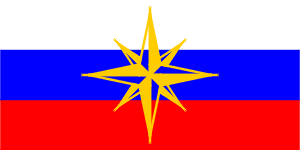
Being guided by the norms of universal human morality, the Baltic Republican Party stands for the return historical name to our city with the world heritage - Königsberg.

Sunday, May 16, 2010

Mission Statement of the Baltic Republican Party. Part I.


As a member of the Baltic Republican Party I represent a program of BRP. The only party which is close to me by the ideology, objectives and in spirit. The activities of the party banned by the Kremlin. 
http://www.enet.ru/ ~ baltia / 

Terms 

In Russia there is a change of social and political formations. At the same time have already occurred stronger social relations, based on - the recognition of individual rights and freedoms, and equality remains in the form of equality of opportunity. 
But the ongoing processes occur extremely unevenly because of the vast territory of Russia. In some regions, democracy already yields the fruits, in others the power remains in the hands of the adherents of the old regime, or random people. However, the absence of real external enemies gives us a historic opportunity to establish democracy in small spaces, to achieve a more equitable social arrangements in a decentralized manner. This contributes to the basic principle upon which the Constitution of Russia is based - the principle of federalism. 
As a representative of the interests and express the will of the economically active part of society, Baltic Republican Party invites his fellow citizens to to make a choice in favour freedom and democracy, in favor of forming a region of an open society and the social market economy. BRP believes that social dependence must give way to the social responsibility of every citizen. 
Power and Policy 
The foreign policy of enclave situation that continue in existence is problematic for the prospects of our community. The reason - current legal status of region. Position of an ordinary subject of the Russian Federation and even the Federal law “About a special economic zone in the Kaliningrad region” are capable just to prolong the agony, but do not give chances for the future. In 2002, the neighboring Poland and Lithuania became members of the European Union, and the area appear alien - subject of isolation - a stain on a single political and economical map of the EU.  In this connection, BRP offers: 
to hold a referendum on status of our region, defining it as a sovereign state - The Baltic Republic - which is the subject of international law and at the same time - an associate entity of the Russian Federation; 
To hold an election of the Constituent Assembly, which will develop and adopt Constitution of the Baltic Republic, as well as the election of the President - as the main guarantor rights and freedoms of citizens; 
To hold an election of supreme legislative authority of the Republic, to be entrusted with the conclusion of the Treaty with Russia on the recognition of our right to sovereignty and the federal division of powers of the Russian Federation and the Baltic Republic. 
This will allow us to regulate  social, domestic economic and foreign relations. This will give us the right to apply for membership in the European Union and the chance that the Republic will become a place of communication and cooperation between the EU and Russia. 

Politics and economics

To be continued ...

Thursday, May 6, 2010

40.000.000.000 $ for Kremlin Fleet in Königsberg.


Ukraine secured a 30% discount for Russian natural gas, expected to cost Russia $40 bln in the next 10 years, in exchange for extending the lease of a Russian naval base.The accords on reducing the price of natural gas for Ukraine and extending the lease for the Russian Black Sea Fleet until 2042 were reached between Russian President Dmitry Medvedev and his Ukrainian counterpart Viktor Yanukovych at the last moment during their meeting in Kharkov in east Ukraine. The lease agreement extends Russian naval presence in the port of Sevastopol for 25 years after the current lease expires in 2017, and may be further extended by another five years.
As European demands on Russian gas drop, monopoly exporter Gazprom seeks to compensate the lower revenues with boosting prices on domestic sales. In 2009, domestic gas prices increased by 46 percent. The company is actively lobbying a further domestic price increase, which eventually will provide equal proportions of its revenues from domestic and foreign sales.That, however, will results in higher power prices for Russian industry, as well as for households. The lion’s share of Russian thermal power plants runs on gas, and higher prices will force them to raise tariffs on electricity and heating for the consumers.
Listen, I also want 40.000.000.000 $ for naval presence of the Kremlin Baltic Fleet in Königsberg, and yes discounts on gas too. I do not know why, but in our region no natural gas in half of cities and villages. It is simply not available or we have expensive liquefied gas. Here for example in Mamonovo that near Polish border, my parents of retirement age without gas. And every election for decades candidates for mayor say that next year, in Mamonovo will be natural gas. Mayors come and go, but still no gas. Not only that we ourselves have got no gas, bloody Kremlin whip away my last money on "investment support" to Ukraine. Beat your own to someone else's fear - the motto of the Kremlin policy.
So here I am, without gas, without money, but with a donut hole - the Kremlin Fleet.

The Kaliningrad Regional Duma supported the project on abolition of visas for residents of the European Union.


The deputies of local Parliament ( Duma) unanimously supported the initiative on simplifying visa regime for EU citizens entering the territory of the Kaliningrad region.
The bill on simplification of visa regime for citizens of the European Union was designed by deputy of the regional Duma Solomon Ginzburg and representatives of the opposition. The introduction of visa-free entry into the region for residents of the European Union, according to project developers, can help residents of Kaliningrad, "after initiative towards the EU, we have the right to demand steps in our direction." Georgy Boos as Governer of Kaliningrad region promised to bring this initiative to the President Dmitry Medvedev. "I think that the decision would be at the right time in anticipation of EU-Russia summit which will be held in Rostov-on-Don on 30 May. Just before the summit, the Governor will meet with Dmitry Medvedev ", - said Deputy Solomon Ginsburg. The bill's authors suggest that the regional government need about a week on consideration of the issue. Let me remind you, 8 years ago, Solomon Ginsburg spoke with a similar legislative initiative, but it was not supported by the State Duma.
Letter to the Governer on simplification of visa regime, signed by the deputies of local Parliament.

Thursday, April 1, 2010

Kaliningrad’s ‘Special Identity’ Requires Restoration Of Federalism In Russia

By Paul Goble
Kaliningrad’s status as a non-contiguous part of the Russian Federation and the rise and intensification of a regional identity combining both Russian and European elements, a local political analyst insists, “requires the restoration [in Russia] of one of the basic principles of federalism – unity in multiplicity.
”If Moscow fails to do that, Solomon Ginzburg argues in the current issue of “NG-Stsenarii,” the current antagonism between Kaliningraders and the governor there is likely to grow into antagonism between that region and Moscow, a development with potentially fateful consequences (www.ng.ru/scenario/2010-03-30/14_kaliningrad.html?mpril).
Ginzburg begins his analysis by pointing to the fundamental fact that “Kaliningrad oblast is a Russian region surrounded by countries which are members of the European Union.” As a result, its residents combine both a Russian identity and a European one, often in a “kaleidoscopic” fashion.
What Kaliningrad and being a Kaliningrader means has changed dramatically over the past 65 years, Ginzburg argues, even though many people outside the region do not understand that reality. When the Soviet Union established it, the region “encountered the traditions and style of foreign Europe.”
But the active in-migration of people from elsewhere in the USSR meant both that its people were both extremely mobile and forced to evolve in new circumstances, something that simultaneously promoted and retarded the development of a distinct regional identity because almost everyone living there was from somewhere else.
Such in-migration largely ceased with the end of the USSR, and since then, “certain features of Kaliningrad identity” have firmed up, Ginzburg writes. “Sixty years ago,” people there focused on being “the most Western” part of the Soviet Union, something that caused “the struggle with Nazi symbols to grow over into a struggle against the past of East Prussia.” Then, approximately 50 years ago, he continues, “Kaliningraders began to feel their regional distinctiveness,” and ten years after that, there arose among them “a fashion for the former, pre-Soviet, German past.” That past instead of being rejected came to be integrated into the Kaliningrad identity.
Then, when the Soviet Union collapsed, Kaliningrader’s sense of being “the most Western” began “to acquire yet another meaning,” one not limited to geography but including in itself “a desire to achieve a high level of life and to achieve a new model of development” as “a new Hong Kong” or “a Singapore on the Baltic.”
But because being “between” Russia and Europe did not mean that Kaliningrad was necessarily a bridge or connected with either and because “the sense of regionalism” annoyed Moscow but not Europe, Kaliningraders “ever more often asked themselves” just what they were part of.
And consequently, it is “senseless” to speak about “a hierarchy of identities” – Russian, regional and European – among Kaliningraders. Instead, in their identity – and Ginzburg makes it clear that he shares it – there are “pieces, segments and fragments of regional, European and Russian identity” which combine in changing ways.
For residents of Kaliningrad who have lived there “more than 20 years,” regional identity is more important than ethnic or confessional membership” and “the territorial factor is beginning to predominate over the national.” Those who have lived there for fewer years generally continue to identify with the Russian Federation.
Nonetheless, “the Kaliningrad identity is not a finally formed system of convictions, capabilities, requirements and personal histories of the residents of the western borderland of Russia.” It is still being affected by “a mass of factors,” including age, faith, language, ethnicity, ideology, political convictions, and so on.
And because that is so, “a particular feature of the Kaliningrad identity is in its kaleidoscopic and mosaic character, when a resident of the oblast at one and the same time calls himself a supporter of integration into Europe” and “a patriotic supporter of the Russian state and an opponent of NATO.”
It is thus entirely possible to say, Ginzburg says, that “the overwhelming majority of Kaliningraders consider themselves residents of a special territory, a different Russia in Europe,” although “an insignificant minority manifests xenophobia toward the neighboring countries in the European Union.”
The sense of distinctiveness has been intensified by the recent wave of demonstrations, Ginzburg says. Indeed, it is fair to speak of their “consolidating role” in that identity. Anger at the regional government and disappointment in Moscow’s policies “have helped to strengthen the desire to go into the European Union.”That is especially true among the young and middle aged, and it is “strengthening the European vector in Kaliningrad identity,” with “the anti-bureaucratic and anti-Boos attitudes being transformed into anti-Moscow and anti-federal ones,” a development that in turn is “strengthening protest identity.”
Moscow needs to recognize the special nature of Kaliningrad and of the identity of its residents and thus move quickly to restore “one of the basic principles of federalism – unity in multiplicity” lest it fail to satisfy the demands of the residents of that region and push them in more radical directions.

Saturday, March 27, 2010

Restlessness in Russia’s Western Outpost.


The New York Times

By MICHAEL SCHWIRTZ
Published: March 25, 2010


KALININGRAD, Russia — Amid the sagging Soviet-era apartment blocks and hulking government buildings here, it can be difficult to imagine that this was once a German city graced with gingerbread-style facades and Teutonic spires.

About all that remains of the 700-year-old city once called Königsberg — which was bombed to oblivion in World War II, then taken over by the Soviet Union and renamed in 1946 after the death of a Bolshevik hero, Mikhail Kalinin — are some weathered houses and a few reconstructed cathedrals. But that does not mean residents of this island of Russian territory wedged between Poland and Lithuania do not entertain certain European expectations.
“I would like to bring Königsberg back to Europe,” Rustam Vasiliev, a local blogger and political activist, said, intentionally using the former German name of this city. “I’ve got no Kremlin in my head.”
People like Mr. Vasiliev have become a headache for the Kremlin, as some of the largest antigovernment protests in Russia in recent years have broken out here, in part because of the failure of officials to bring the region more in line with the standards of Western Europe.
The Kremlin has had similar problems in other far-flung regions, notably in the Far Eastern city of Vladivostok, where the economy has been drawn into the orbit of local Asian powers.
Here in Russia’s western extreme, people take pride in their European cars but complain about their city’s pocked roads. Advertisements for concerts in Warsaw and Berlin hang on the crumbling facades of long-neglected apartment buildings. When local people talk of Russia, they often seem to mean not their own country, but some foreign land to the east.
“We are located outside of Russia’s borders and within the borders of the European Union,” said Vytautas V. Lopata, a cafe owner and local independent politician. “Here, people are freer. They see how people live in Europe; they have heightened demands.”
When it comes to politics, Kaliningrad is by no means a thriving democracy. People here have nevertheless come to enjoy a level of openness not found elsewhere in Russia. There are independent television stations and real opposition politicians in the local Parliament (though their influence is minimal). Small street protests are not uncommon and are generally tolerated by the authorities.
By contrast, even the tiniest antigovernment demonstrations in Moscow are quashed by riot troops, sometimes violently. And when protests broke out in Vladivostok last year, the authorities sent those same Moscow riot troops to suppress them.
But officials both here and in Moscow were clearly caught off guard in January when as many as 10,000 people poured into a central Kaliningrad square to demand the resignation of the regional governor and other officials from Prime Minister Vladimir V. Putin’s political party, United Russia.
Since then, the authorities have been scrambling to contain the damage lest the dissatisfaction in Kaliningrad spread to the rest of the country. They were able to head off another protest scheduled for last weekend, in part by making serious promises to opposition leaders to resolve their major complaints.
Still, it is unclear how long the tentative peace will hold, especially given that there has been no shortage of unfulfilled promises here.
Though Kaliningrad remained under Moscow’s control after the Soviet collapse, its location outside contiguous Russia seemed to hold out the promise that the formerly sealed military zone would be opened to the prosperity of the West.
But membership in the European club has always been elusive, to the dismay of many here. The region remained relatively poor, even as its neighbors — until recently, at least — prospered. Like all Russians, Kaliningraders must submit to the lengthy process of applying for visas to visit cities a few hours’ drive away.
“Here we are like fish in an aquarium,” said Konstantin Doroshok, one of the leaders of the January protests. “And the water has not been changed in a while, and we are going extinct.”
Things did not always feel this constricted, Mr. Doroshok, 40, said. Just a few years ago, he and many others were doing good business importing European cars into Kaliningrad to resell to Russians farther east, one of many similar professions that thrived here because import tariffs from European countries into Kaliningrad were cheaper than those for the rest of Russia.
A year ago, however, the Kremlin sharply increased customs duties on imported cars, which Mr. Doroshok said effectively killed his business. He was also slapped with what he said were fabricated charges of failing to pay customs duties and fined about $600,000.
“One fine day it seems that one of the oligarchs calculated how much he failed to earn as a result of the fact that citizens of Russia were importing automobiles independently,” he said, “and decided to try to push us out of this business.”
It was then that Mr. Doroshok and others angry over Kremlin interference in their way of life decided to push back.
A series of demonstrations culminating in the large January protests compelled Kaliningrad’s Kremlin-appointed governor, Georgy V. Boos, for the first time to hold serious talks with opposition leaders, including Mr. Doroshok. Though protest leaders called off a planned demonstration last week, several hundred people gathered in central Kaliningrad, shouting “Down with Boos!”
“There was an underestimation by us and me personally of the need to devote more time to communicating with people,” Mr. Boos said of the protests at a news conference here last week.
To deflect some of the ill will directed at the governing authorities here, some local United Russia leaders have even floated the idea of relinquishing some of the party’s near monopoly on power — something that might be considered blasphemous elsewhere in the country.
“That would lower some of the political strain and allow for more democratic governance,” said Konstantin I. Poliakov, the deputy head of United Russia’s faction in the regional Parliament.
Many, like Mr. Lopata, the cafe owner, say that it makes little difference to the people of Kaliningrad who their leaders are as long as their region remains cut off from their real neighbors and under Moscow’s thumb.
“We live within the European Union,” Mr. Lopata said. “But it turns out that we live behind a fence.”

Thursday, March 25, 2010

A new kind of apartheid in Kaliningrad.


I was brought up in Soviet good times, by the good school education. With mother's milk we have taken such slogans as, "we are not slaves - slaves are mute". But I never imagined that in a few years, in the heart of Europe, in the 21 th century, I have personally come across with the meaning of this phrase.
A lot of similarities in Kaliningrad with the past and present of South Africa. Apartheid in South Africa ordered the black and mixed ancestry (so-called. Coloured) people to live in special reservations (Bantustans). Departure from the reservation could be made only by special permission or because of job availability. That is a direct analogy with the current visa regulations for Kaliningradians. During apartheid, blacks were deprived of almost all civil rights. As a result, people of not white race, even living in "white" parts of South Africa, had no right to vote nor the ability to influence political processes. Moscow government has deprived Kaliningradians right to elect and the right to be elected. Kaliningraders have no right to elect the local governor. Kaliningraders even denied the right to elect their own mayor
of Kaliningrad. As a result kremlin authorities do not permit us Kaliningraders to gather on political rally where we want. We want it in center of Kaliningrad).
The enclave situation of our region is similar to Lesotho. Political parties are remain banned by kremlin authorities, as they did with our Baltic Republican Party, exactly like in Swaziland. Moscow colonial authorities appointed in banana republic ( Kaliningrad) "white" Governors as they do not trust the "aborigines" ( Kaliningraders). Many of the methods used by black people in South Africa in defence of their rights, but the most effective that overthrew apartheid was a boycott of consumption. They did not buy from the whites even matches. I'm afraid we are Kalinigraders to far from that kind of unity. The Rome Statute defines apartheid as one of 11 crimes against humanity. Citizens of most countries (including South Africa) may be brought against the International Criminal Court for committing such crime or even fostering that. Russia has not ratified the Rome Statute ( opposed in that to 108 countries) and not under International Criminal Court. Replaced Soviet slogans of my childhood came to the realities of today's slogans - "A slave who is not seeking to gain freedom, deserves double slavery" - Dzhokhar Dudayev.
The colonists in South Africa (Boers) at the end realized that they do not need imperial authorities such as Great Britain, because they have more rights, it is their land. I am glad that I am mostly surrounded by free citizens of Konigsberg, the citizens of the Baltic Republic.

Sunday, March 21, 2010

Thousands Rally In Kaliningrad.


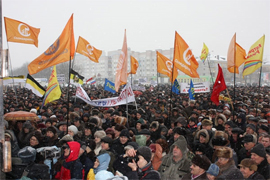
Thousands of people have rallied in Koenigsberg despite a decision by "opposition leaders" to cancel the protest. People gathered to denounce the government's economic policy and demand more freedom in a new challenge to the Kremlin reflecting increasing disillusionment and a growing potential for protests.


Me with my kremlin friends.

Cries of "freedom" and "Putin resign" filled the main square in Koenigsberg, where up to 5,000 people gathered in pouring rain.


Activists have insisted the Russian constitution guarantees the right of assembly.


Some protesters criticized Putin's Cabinet for failing to compensate for a rise in utility tariffs that has affected living standards. Many others blamed the government for red tape and rampant corruption that have stifled business.
Instead prohibited demonstration there was a “Tangerine flashmob” - members were holding tangerines. Tangerine ("mandarin" in russian and bureaucrat in imperial China) is one of the nicknames of governor Georgy Boos. Many participants have covered their faces with medical masks. It symbolizes the lack of freedom of speech in the country. Opposition supporters had badges with crossed bear and words “Stop United Russia “.
In anticipation of the impending action police and department "E" ( extremism) came home to known activists and bloggers. In “preventive talks” police recommended “sit at home on Saturday". But who cares, we have done it.

Saturday, March 13, 2010

To be or not to be?


Kaliningrad opposition coalition had refused to conduct a protest rally on March 20. This announcement was made today, the leader of the NGO “Justice” Konstantin Doroshok.
According Doroshok, Kaliningrad Governor Georgy Boos promised that “the demands of the opposition formed a single list, which will be submitted to the government the next few days, will be resolved within a specific timeframe.” The leader of “Justice” explained that it concerns the issues of excessive utility tariffs, public health, land administration, the situation with the elections and some others. “Today we get a , which appeared on previous protests. We heard, we are addressing specific issues. But if the promises will remain empty words, we will again hold a mass protest “, – emphasized Doroshok.
He added that the authorities did everything to disrupt the rally. For example, Kaliningrad is not allowed to hold a rally in the city center, and offered to organize it in remote areas of the city. “The options endanger the life, health, and, most importantly, the safety of all its members” – said Doroshok.
He noted that holding a meeting “for the city” could become a “public flogging”. At the same time, the leader of the Communist Party offices Igor Revin stated that ” on behalf of the parties to refrain from the idea to abandon the rally. He added: “If we knew that the” Justice “can so easily believe the authorities and to succumb to its pressure, we would have applied themselves to hold a meeting on March 20″.
The region’s reviled governor, the Kremlin-appointed Georgy Boos met with the local opposition leaders in his office for four and half hours, and at the same time, in the city’s stadium four hundred yards away, two battalions of riot police were practicing how to bust heads and arrest people. The opposition got the message. They called off their demonstration.
“There are suspicions … that the government is preparing to make an example out of us, to beat the protesting mood out of the people,” said an opposition member of the city council, Solomon Ginzburg. “We can’t subject our citizens to fire houses and rubber bullets.”
What they got in exchange for quiet were ridiculous promises. Boos said he would break the political monopoly of Putin’s party in Kaliningrad, he would lower utility prices and taxes, he would create jobs and housing and better health care. He might as well have promised to turn the region into Switzerland. But the people believed him, or are at least pretending to. The point is they still aren’t ready for a fight, and having seen the way OMON riot cops break up protests in Moscow, I don’t really blame them. But it’s sad. I thought it may have been the start of something.
But me personally, I`m going with my friends and members of Baltic Republican Party on 20th of March to support rally and we do not care about Kremlin`s riot police. Freedom has it`s price.

Friday, March 5, 2010

Kaliningrad Rally Organizers Form New Coalition


Organizers of a massive anti-government protest in Kaliningrad have come together in a political coalition that they hope will provide a viable alternative to the ruling United Russia party.

Rally organizer and coalition co-founder Konstantin Doroshok said that a founding assembly was held on Wednesday, but leaders have yet to settle on a name for the new union.

The January 30 protest in Kaliningrad, in which 12 thousand people participated, was notable both for its massive size and for the diversity of political forces represented. The new coalition features similar diversity, including the Kaliningrad branches of the parties Solidarity, Justice, A Just Russia, Patriots of Russia, Yabloko, and the Communist Party.

 Coalition leaders invited the local branch of the Right Cause party to join the union, but leader Mikhail Tsikel declined the proposal. The ultranationalist Liberal Democratic Party is also not included in the coalition.

Doroshok said that the union’s main goal is “to break the political monopoly of United Russia,” Prime Minister Vladimir Putin’s ruling party, which has dominated the country’s elections at every level since its inception in 2001.

Kaliningrad residents have been threatened with losing their jobs or having their wages slashed if they take part in the coalition’s upcoming rally on March 20. Likewise, students have been promised that they will be expelled.

Meanwhile, the Kaliningrad Public Chamber was set to meet on Thursday with the Public Chamber of Russia to discuss the situation in the region, which has been a media spotlight since January’s massive rally. A relatively new institution, the Public Chamber is an oversight body intended to monitor government activities.

Protesters in the January 30 rally gathered in Kaliningrad to collectively demand that high vehicle tariffs be annulled and that Kaliningrad Governor Georgy Boos and Prime Minister Putin both resign. Boos immediately cancelled his vacation plans and promised to meet with opposition leaders, although he cancelled multiple times before finally meeting with Doroshok on February 26.

Another rally of more than a thousand Kaliningrad residents was held in the city of Yernyakhovsk on February 28, and a demonstration of comparable size to the one on January 30 is scheduled for March 20.

Wednesday, February 10, 2010

Zehn Thesen zur Zukunft von Königsberg

From  http://www.ostpreussen.org/Haupt/TKoenigThesen.html

1.

Für den Wiederaufbau Königsbergs ist eine Besinnung auf die Geschichte Ostpreußens Voraussetzung.

Vor 700 Jahren war Ostpreußen der modernste Staat nördlich der Alpen, seit dieser Zeit des deutschen Ordens bestand hier eine einzigartige Wiege europäischer Kultur, Kopernikus und Kant stehen symbolisch für geistige Revolutionen, die von hier ihren Ausgang nahmen. Russen und Deutsche müssen sich gemeinsam auf dieses Erbe besinnen. Nur wer sich erinnert, hat Phantasie. Nur mit Phantasie kann die Zukunft Königsbergs gelingen.

2.
Nur gemeinsam können Russen und Deutsche den Wiederaufbau Nordostpreußens erreichen.

Die Beseitigung der deutschen Bevölkerung bedeutet einen Bruch in der Geschichte, der bisher nicht überwunden ist. Daß mit den Menschen auch fast alles hinweggefegt worden ist, was von Genie, Kunstsinn und Fleiß seiner ursprünglichen Bewohner zeugen könnte, lastet wie ein Fluch über diesem Land. Hieran tragen die jetzigen Einwohner von Königsberg keine Schuld. Aber auch sie spären etwas von dem Unbegreiflichen, das über diesem Lande liegt. Viele erkennen, daß der Ausschluß der deutschen Menschen, nicht fortbestehen darf. Diesem Land ein Stück seiner Identität zurückzugeben, ist ein purer Akt der Wahrhaftigkeit.

3.
Königsberg hat seine Funktion als Militärkolonie verloren, zurück bleibt ein weitgehend leeres und verödetes Land.

Mehr als die Hälfte der hier lebenden 800.000 Menschen sind Soldaten der Roten Armee und deren Angehörige. Als Kriegstrophäe Stalins wurde das Gebiet über 40 Jahre von Militärs wie ein Truppenübungsplatz verwaltet. Das flache Land blieb großenteils menschenleer. Während auf einer Fläche gleicher Größe in Schleswig-Holstein und Hamburg etwa 4,5 Millionen Menschen leben, beläuft sich die Zahl der wirklich "Einheimischen" in Nordostpreußen werden auf etwa 400 000. Eine Infrastruktur oder ein tragfähiges Wirtschaftsleben konnten sich hier nicht entwickeln.

4.
Heute ist Königsberg eine völlig verarmte Region, ein "Klotz am Bein" der ohnehin schon problemgeschüttelten Russischen Föderation.

Die einstige Kornkammer Deutschlands kann heute nicht einmal ihre spärliche Bevölkerung ernähren, Lebensmittel und fast alle Waren müssen importiert werden. Königsberg hängt am Tropf des darbenden Riesenreiches, für Moskau ist seine westliche Exklave zu einer Belastung geworden. Ohne Hilfe von außen droht das Chaos. Woher soll diese Hilfe kommen? Wer fühlt sich diesem Lande mehr verbunden als die Deutschen? Nur sie können und wollen helfen.

5.
Hierzu ist eine schwierige Einsicht nötig: Die Wiederherstellung einer deutschen Identität neben der russischen ist die Voraussetzung für eine erfolgreiche eine erfolgreiche Zukunft Königsbergs.

Hier sind leicht Mißverständnisse möglich, niemand will der russischen Bevölkerung irgendetwas wegnehmen. Nur: Damit deutsche Menschen Arbeit, Fleiß und Reichtum in dieses Land stecken, müssen sie sicher sein, daß nicht irgendein Machthaber ihnen wieder alles wegnehmen kann. Unwiderrufliche Rechte können sie nur als gleichberechtigte Bürger dieses Landes erhalten. Deutsche und Russen müssen hier mit gleichem Recht sagen können: Wir sind Bürger von Königsberg.

6.
Die Rückkehr von Deutschen wäre ein Segen für das Land, die russische Bevölkerung würde nicht verlieren, sondern sehr viel gewinnen.

Wem könnte es schaden, wenn die Menschen, die einmal hier wohnten, die ungenutzten Grundstücke, die längst verfallenen Häuser, wieder in ihren Besitz nähmen? Durch ihren Einsatz könnten alle in Ostpreußen nur gewinnen. Genug Land für eine großzügige Rückgabe ist da.  Dies wäre ein Symbol der Versöhnung und ein Brückenschlag in ein neues Europa. Rußlands Weg nach Europa führt über Königsberg.

7.
Die Wiederherstellung eine deutschen Identität bedeutet nicht die staatliche Zugehörigkeit zur Bundesrepublik Deutschland, jede Regelung muß das Recht der russischen Bevölkerung respektieren.

Königsberg könnte durch die Rückkehr von Deutschen viel von dem gewinnen, was den deutschen Staat ausmacht: ein kulturelles Leben mit deutscher Sprache, soziale Sicherheit, Wohlstand und Freiheit. Fast alles davon käme auch den Russen in gleichem Maße zugute. Über ihren Willen kann sich niemand hinwegsetzen, alte Ängste vor deutscher Übermacht sind schon zu lange mißbraucht worden, sie passen nicht mehr in unsere Zeit. Heute muß jedem klar sein: Nur gemeinsam haben wir eine Zukunft.

8.
Die Rußlanddeutschen können entscheidend zur Wiedergeburt Ostpreußens beitragen, wenn sie das Angebot des Regierungschefs von Königsberg zur Ansiedlung von 200.000 Rußland-Deutschen annehmen.

Sie sind die idealen Partner in Königsberg. Mit ihnen gibt es keine Verständigungsprobleme, sie sprechen perfekt Russisch und haben alle Erfahrungen des russischen Volkes in den letzten 200 Jahren mitgemacht. Durch ihren Fleiß und ihren unumstößlichen Willen zum Neubeginn könnten sie mit der Hilfe aus Deutschland in wenigen Jahren Königsberg auf das wirtschaftliche Niveau Westeuropas bringen. Somit würden sie ihrer alten Rolle gerecht, sie wären eine Brücke zwischen Deutschen und Russen.

9.
Eine autonome Republik Königsberg unter dem Schutze von Rußland und Deutschland könnte für beide Staaten sehr nützlich sein.

Beide Länder sollten dem nördlichen Ostpreußen eine weitgehende Selbstverwaltung ermöglichen und als Garantie- und Schutzmächte nur die Rahmenbedingungen dieses Gemeinwesens festlegen. Bis auf die Fragen der Äußeren Sicherheit und des inneren Gleichgewichts könnten die Bürger von Königsberg ihr Leben selbst bestimmen. Für Rußland wäre dieses Gebiet durch einen regen Austausch von Fachkräften, Wissen und Gütern das weit offene Tor zum Westen, für Deutschland wäre es der Haupthandelsplatz im Osten. In dieser Mittellage würde Königsberg schnell zu neuer Blüte erstehen.

10.
Königsberg kann zum Modell einermodernen Staatswesens im 21. Jahrhundert werden, wenn Russen und Deutsche diese Aufgabe als eine gemeinsame Herausforderung annehmen.

In der Stadt des Philosophen Kant treffen heute auf engem Raum die Weltprobleme einer neuen Zeit aufeinander. Zu ihrer Lösung könnten auch die Ideale von Pflichtgefühl und Bescheidenheit beitragen, die als preußische Tugenden einst Grundlage für das Wohlergehen Ostpreußens waren. Eine Rückbesinnung auf diese Traditionen und die Erfahrungen zweier großer Völker wäre ein gutes Fundament für ein neues Königsberg. Seine Zukunft könnte die Fortsetzung einer großen Vergangenheit sein.