Sunday, March 21, 2010

Thousands Rally In Kaliningrad.


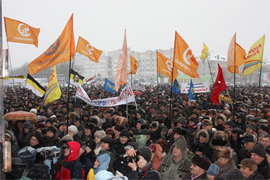
Thousands of people have rallied in Koenigsberg despite a decision by "opposition leaders" to cancel the protest. People gathered to denounce the government's economic policy and demand more freedom in a new challenge to the Kremlin reflecting increasing disillusionment and a growing potential for protests.


Me with my kremlin friends.

Cries of "freedom" and "Putin resign" filled the main square in Koenigsberg, where up to 5,000 people gathered in pouring rain.


Activists have insisted the Russian constitution guarantees the right of assembly.


Some protesters criticized Putin's Cabinet for failing to compensate for a rise in utility tariffs that has affected living standards. Many others blamed the government for red tape and rampant corruption that have stifled business.
Instead prohibited demonstration there was a “Tangerine flashmob” - members were holding tangerines. Tangerine ("mandarin" in russian and bureaucrat in imperial China) is one of the nicknames of governor Georgy Boos. Many participants have covered their faces with medical masks. It symbolizes the lack of freedom of speech in the country. Opposition supporters had badges with crossed bear and words “Stop United Russia “.
In anticipation of the impending action police and department "E" ( extremism) came home to known activists and bloggers. In “preventive talks” police recommended “sit at home on Saturday". But who cares, we have done it.

Saturday, March 13, 2010

To be or not to be?


Kaliningrad opposition coalition had refused to conduct a protest rally on March 20. This announcement was made today, the leader of the NGO “Justice” Konstantin Doroshok.
According Doroshok, Kaliningrad Governor Georgy Boos promised that “the demands of the opposition formed a single list, which will be submitted to the government the next few days, will be resolved within a specific timeframe.” The leader of “Justice” explained that it concerns the issues of excessive utility tariffs, public health, land administration, the situation with the elections and some others. “Today we get a , which appeared on previous protests. We heard, we are addressing specific issues. But if the promises will remain empty words, we will again hold a mass protest “, – emphasized Doroshok.
He added that the authorities did everything to disrupt the rally. For example, Kaliningrad is not allowed to hold a rally in the city center, and offered to organize it in remote areas of the city. “The options endanger the life, health, and, most importantly, the safety of all its members” – said Doroshok.
He noted that holding a meeting “for the city” could become a “public flogging”. At the same time, the leader of the Communist Party offices Igor Revin stated that ” on behalf of the parties to refrain from the idea to abandon the rally. He added: “If we knew that the” Justice “can so easily believe the authorities and to succumb to its pressure, we would have applied themselves to hold a meeting on March 20″.
The region’s reviled governor, the Kremlin-appointed Georgy Boos met with the local opposition leaders in his office for four and half hours, and at the same time, in the city’s stadium four hundred yards away, two battalions of riot police were practicing how to bust heads and arrest people. The opposition got the message. They called off their demonstration.
“There are suspicions … that the government is preparing to make an example out of us, to beat the protesting mood out of the people,” said an opposition member of the city council, Solomon Ginzburg. “We can’t subject our citizens to fire houses and rubber bullets.”
What they got in exchange for quiet were ridiculous promises. Boos said he would break the political monopoly of Putin’s party in Kaliningrad, he would lower utility prices and taxes, he would create jobs and housing and better health care. He might as well have promised to turn the region into Switzerland. But the people believed him, or are at least pretending to. The point is they still aren’t ready for a fight, and having seen the way OMON riot cops break up protests in Moscow, I don’t really blame them. But it’s sad. I thought it may have been the start of something.
But me personally, I`m going with my friends and members of Baltic Republican Party on 20th of March to support rally and we do not care about Kremlin`s riot police. Freedom has it`s price.

Friday, March 5, 2010

Kaliningrad Rally Organizers Form New Coalition


Organizers of a massive anti-government protest in Kaliningrad have come together in a political coalition that they hope will provide a viable alternative to the ruling United Russia party.

Rally organizer and coalition co-founder Konstantin Doroshok said that a founding assembly was held on Wednesday, but leaders have yet to settle on a name for the new union.

The January 30 protest in Kaliningrad, in which 12 thousand people participated, was notable both for its massive size and for the diversity of political forces represented. The new coalition features similar diversity, including the Kaliningrad branches of the parties Solidarity, Justice, A Just Russia, Patriots of Russia, Yabloko, and the Communist Party.

 Coalition leaders invited the local branch of the Right Cause party to join the union, but leader Mikhail Tsikel declined the proposal. The ultranationalist Liberal Democratic Party is also not included in the coalition.

Doroshok said that the union’s main goal is “to break the political monopoly of United Russia,” Prime Minister Vladimir Putin’s ruling party, which has dominated the country’s elections at every level since its inception in 2001.

Kaliningrad residents have been threatened with losing their jobs or having their wages slashed if they take part in the coalition’s upcoming rally on March 20. Likewise, students have been promised that they will be expelled.

Meanwhile, the Kaliningrad Public Chamber was set to meet on Thursday with the Public Chamber of Russia to discuss the situation in the region, which has been a media spotlight since January’s massive rally. A relatively new institution, the Public Chamber is an oversight body intended to monitor government activities.

Protesters in the January 30 rally gathered in Kaliningrad to collectively demand that high vehicle tariffs be annulled and that Kaliningrad Governor Georgy Boos and Prime Minister Putin both resign. Boos immediately cancelled his vacation plans and promised to meet with opposition leaders, although he cancelled multiple times before finally meeting with Doroshok on February 26.

Another rally of more than a thousand Kaliningrad residents was held in the city of Yernyakhovsk on February 28, and a demonstration of comparable size to the one on January 30 is scheduled for March 20.

Wednesday, February 10, 2010

Zehn Thesen zur Zukunft von Königsberg

From  http://www.ostpreussen.org/Haupt/TKoenigThesen.html

1.

Für den Wiederaufbau Königsbergs ist eine Besinnung auf die Geschichte Ostpreußens Voraussetzung.

Vor 700 Jahren war Ostpreußen der modernste Staat nördlich der Alpen, seit dieser Zeit des deutschen Ordens bestand hier eine einzigartige Wiege europäischer Kultur, Kopernikus und Kant stehen symbolisch für geistige Revolutionen, die von hier ihren Ausgang nahmen. Russen und Deutsche müssen sich gemeinsam auf dieses Erbe besinnen. Nur wer sich erinnert, hat Phantasie. Nur mit Phantasie kann die Zukunft Königsbergs gelingen.

2.
Nur gemeinsam können Russen und Deutsche den Wiederaufbau Nordostpreußens erreichen.

Die Beseitigung der deutschen Bevölkerung bedeutet einen Bruch in der Geschichte, der bisher nicht überwunden ist. Daß mit den Menschen auch fast alles hinweggefegt worden ist, was von Genie, Kunstsinn und Fleiß seiner ursprünglichen Bewohner zeugen könnte, lastet wie ein Fluch über diesem Land. Hieran tragen die jetzigen Einwohner von Königsberg keine Schuld. Aber auch sie spären etwas von dem Unbegreiflichen, das über diesem Lande liegt. Viele erkennen, daß der Ausschluß der deutschen Menschen, nicht fortbestehen darf. Diesem Land ein Stück seiner Identität zurückzugeben, ist ein purer Akt der Wahrhaftigkeit.

3.
Königsberg hat seine Funktion als Militärkolonie verloren, zurück bleibt ein weitgehend leeres und verödetes Land.

Mehr als die Hälfte der hier lebenden 800.000 Menschen sind Soldaten der Roten Armee und deren Angehörige. Als Kriegstrophäe Stalins wurde das Gebiet über 40 Jahre von Militärs wie ein Truppenübungsplatz verwaltet. Das flache Land blieb großenteils menschenleer. Während auf einer Fläche gleicher Größe in Schleswig-Holstein und Hamburg etwa 4,5 Millionen Menschen leben, beläuft sich die Zahl der wirklich "Einheimischen" in Nordostpreußen werden auf etwa 400 000. Eine Infrastruktur oder ein tragfähiges Wirtschaftsleben konnten sich hier nicht entwickeln.

4.
Heute ist Königsberg eine völlig verarmte Region, ein "Klotz am Bein" der ohnehin schon problemgeschüttelten Russischen Föderation.

Die einstige Kornkammer Deutschlands kann heute nicht einmal ihre spärliche Bevölkerung ernähren, Lebensmittel und fast alle Waren müssen importiert werden. Königsberg hängt am Tropf des darbenden Riesenreiches, für Moskau ist seine westliche Exklave zu einer Belastung geworden. Ohne Hilfe von außen droht das Chaos. Woher soll diese Hilfe kommen? Wer fühlt sich diesem Lande mehr verbunden als die Deutschen? Nur sie können und wollen helfen.

5.
Hierzu ist eine schwierige Einsicht nötig: Die Wiederherstellung einer deutschen Identität neben der russischen ist die Voraussetzung für eine erfolgreiche eine erfolgreiche Zukunft Königsbergs.

Hier sind leicht Mißverständnisse möglich, niemand will der russischen Bevölkerung irgendetwas wegnehmen. Nur: Damit deutsche Menschen Arbeit, Fleiß und Reichtum in dieses Land stecken, müssen sie sicher sein, daß nicht irgendein Machthaber ihnen wieder alles wegnehmen kann. Unwiderrufliche Rechte können sie nur als gleichberechtigte Bürger dieses Landes erhalten. Deutsche und Russen müssen hier mit gleichem Recht sagen können: Wir sind Bürger von Königsberg.

6.
Die Rückkehr von Deutschen wäre ein Segen für das Land, die russische Bevölkerung würde nicht verlieren, sondern sehr viel gewinnen.

Wem könnte es schaden, wenn die Menschen, die einmal hier wohnten, die ungenutzten Grundstücke, die längst verfallenen Häuser, wieder in ihren Besitz nähmen? Durch ihren Einsatz könnten alle in Ostpreußen nur gewinnen. Genug Land für eine großzügige Rückgabe ist da.  Dies wäre ein Symbol der Versöhnung und ein Brückenschlag in ein neues Europa. Rußlands Weg nach Europa führt über Königsberg.

7.
Die Wiederherstellung eine deutschen Identität bedeutet nicht die staatliche Zugehörigkeit zur Bundesrepublik Deutschland, jede Regelung muß das Recht der russischen Bevölkerung respektieren.

Königsberg könnte durch die Rückkehr von Deutschen viel von dem gewinnen, was den deutschen Staat ausmacht: ein kulturelles Leben mit deutscher Sprache, soziale Sicherheit, Wohlstand und Freiheit. Fast alles davon käme auch den Russen in gleichem Maße zugute. Über ihren Willen kann sich niemand hinwegsetzen, alte Ängste vor deutscher Übermacht sind schon zu lange mißbraucht worden, sie passen nicht mehr in unsere Zeit. Heute muß jedem klar sein: Nur gemeinsam haben wir eine Zukunft.

8.
Die Rußlanddeutschen können entscheidend zur Wiedergeburt Ostpreußens beitragen, wenn sie das Angebot des Regierungschefs von Königsberg zur Ansiedlung von 200.000 Rußland-Deutschen annehmen.

Sie sind die idealen Partner in Königsberg. Mit ihnen gibt es keine Verständigungsprobleme, sie sprechen perfekt Russisch und haben alle Erfahrungen des russischen Volkes in den letzten 200 Jahren mitgemacht. Durch ihren Fleiß und ihren unumstößlichen Willen zum Neubeginn könnten sie mit der Hilfe aus Deutschland in wenigen Jahren Königsberg auf das wirtschaftliche Niveau Westeuropas bringen. Somit würden sie ihrer alten Rolle gerecht, sie wären eine Brücke zwischen Deutschen und Russen.

9.
Eine autonome Republik Königsberg unter dem Schutze von Rußland und Deutschland könnte für beide Staaten sehr nützlich sein.

Beide Länder sollten dem nördlichen Ostpreußen eine weitgehende Selbstverwaltung ermöglichen und als Garantie- und Schutzmächte nur die Rahmenbedingungen dieses Gemeinwesens festlegen. Bis auf die Fragen der Äußeren Sicherheit und des inneren Gleichgewichts könnten die Bürger von Königsberg ihr Leben selbst bestimmen. Für Rußland wäre dieses Gebiet durch einen regen Austausch von Fachkräften, Wissen und Gütern das weit offene Tor zum Westen, für Deutschland wäre es der Haupthandelsplatz im Osten. In dieser Mittellage würde Königsberg schnell zu neuer Blüte erstehen.

10.
Königsberg kann zum Modell einermodernen Staatswesens im 21. Jahrhundert werden, wenn Russen und Deutsche diese Aufgabe als eine gemeinsame Herausforderung annehmen.

In der Stadt des Philosophen Kant treffen heute auf engem Raum die Weltprobleme einer neuen Zeit aufeinander. Zu ihrer Lösung könnten auch die Ideale von Pflichtgefühl und Bescheidenheit beitragen, die als preußische Tugenden einst Grundlage für das Wohlergehen Ostpreußens waren. Eine Rückbesinnung auf diese Traditionen und die Erfahrungen zweier großer Völker wäre ein gutes Fundament für ein neues Königsberg. Seine Zukunft könnte die Fortsetzung einer großen Vergangenheit sein.

Sunday, January 31, 2010

Power to the People!


"Bring back governors' elections"

   Twelve thousand people have attended a rally in the Russian Baltic enclave of Kaliningrad calling for the resignation of Prime Minister Vladimir Putin.   

Exasperation over the rising cost of living coupled with unemployment led to the rare public show of anger according to protest organizers.

   Boris Nemtsov, a former deputy prime minister and leader of the opposition Solidarity movement addressed the cheering crowd. ( Me on 1m29s :))   

   “How strong must the feelings of Kaliningrad be that here today, together, are the flags of the Communist Party, Yabloko, the Patriots of Russia Party, Solidarity and LDPR. We are all united,” he said.

   Despite signs of economic improvement, Russia remains mired in financial crisis. Unemployment reached 8.9 per cent in December.

   Organised by local rights group Spravedlivost ("Justice", leader Konstantin Doroshok), and attended by supporters of Solidarity, the Communist and the Liberal Democrat parties, participants held up banners denouncing both local governor Georgy Boos and Russian Prime Minister Vladimir Putin for increasing utility prices at a time of economic crisis. They also booed the refusal of the government to reinstate the direct popular election of regional governors, abolished by Putin in 2004. The 83 governors are currently chosen directly by the president.   

   What was particularly unusual about the mass protest in Kaliningrad, is that unlike most public demonstrations in Russia, this one was left untouched by riot police. The explanation presented by many is quite simple - protests are usually dispersed by riot police squads from other regions, but it's not easy to bring external forces into Kaliningrad, due to the fact that it's geographically separated from the rest of the country, with Latvia, Lithuania and Belarus in-between. The region is very close-knit, so getting the local police to arrest what could be their relatives or close friends is a rather complicated task.  

   People chanted "Partiya YedRo - Pomoinoye Vedro" ("United Russia is a bucket of filth") and "Putin is responsible for Boos" (Georgy Boos is the Kaliningrad governor who was appointed by Putin in 2005).  "  "Stop increasing the tariffs. We're against the government's antisocial policies and United Russia. It's Putin who's responsible" 

Thursday, January 7, 2010

Guess Who Was The Last Person To Visit Kaliningrad Easily?


   http://www.petersblurb.com/?p=801

   Back in the 1930s, Hitler would catch a train from Berlin to Konigsberg. It took him 8 hours.

   Today, it takes all of 8 hours just to get from Gdansk in Poland, just 125 kilometers away. The miserably slow border isn’t the only problem. In December, Poland cancelled the overnight sleeper to Berlin. It will now take you 20 hours travel time and four trains minimum to repeat Hitler’s journey.

   Last time I looked, a regular daytime journey to Berlin took 35 hours. Er, no, I didn’t book a ticket.
   So far, Moscow hasn’t cancelled its own Kaliningrad special, the ‘Amber Train‘, but lack of interest might do it. Here’s the schedule:
   The Amber train to Kaliningrad departs from Moscow at 2 p.m with a hard day’s night ahead of every passenger.
At 2 a.m. conductors wake everyone up for a forty minute halt at Gudogai, and a papers and baggage check at the Belarussian border.
   At 3 a.m. the train arrives in Kena, Lithuania, and the same procedure is repeated at the Lithuanian border. At 4.15 a.m. the train is due at Vilnius, and there is a twenty-minute halt with random checks. At 6.30 a.m. there is a Lithuanian state border again with another round of formalities, so you won’t be able to sleep even in the morning.
   At 7.45 a.m. there is one more border, this time a Russian one (Nesterov), and you undergo another forty-minute check. Finally the train arrives in Kaliningrad at 10.45 a.m.
The progressive isolation of Kaliningrad is why residents call their unfortunate region, ‘The European Prison‘. It’s becoming as closed a closed town as it was in Soviet times. But this time, the EU is the jailer and Poland’s action amounts to throwing away the key.
  If you’re looking for someone to name and shame, it is:

Gunnar Wiegand

Acting Director Eastern Europe, South Caucasus, Central Asian Republics, Head of Unit for Relations with Russia, Northern Dimension Policy, European Commission

Kaliningrad’s ghettoisation falls under the EU’s ‘Northern Dimension Policy’. Could Hitler have thought up a more sinister sounding name?

Sunday, December 20, 2009

The signing of the Polish-Swedish Agreement on locating a Swedish consular officer in the premises of the Consulate General of the Republic of Poland


    The Polish-Swedish Agreement on locating a Swedish consular officer in the premises of the Consulate General of the Republic of Poland in Kaliningrad was signed on 18 December 2009. The contracting parties are the Ministry of Foreign Affairs of the Republic of Poland and the Government Offices of Sweden (Foreign Ministry). The Agreement was signed by MFA Director-General Rafał Wiśniewski and the Swedish Ambassador to Warsaw Dag Hartelius.
   Under Visa Code, which comes into effect on 5 April 2010, the Schengen states will be represented in terms of visa issuing in all third countries whose nationals are required to have visas on crossing external borders. However, due to financial constraints many EU Member States have closed a number of their diplomatic posts. This situation creates an incentive to tighten consular cooperation between the EU Member States. Such cooperation can be ensured either by means of visa representation, i.e. issuing visas on behalf of a Member State with no diplomatic post in a given country, or by allocation, i.e. locating a consul in the premises of a diplomatic post or a consular office of another Member State.
   With no diplomatic posts in many African and South American countries, Poland is greatly interested in developing such cooperation by means of the vast network of EU diplomatic posts in these regions. In return, Poland is ready to offer similar assistance in the regions where its diplomatic posts are the most numerous, e.g. in Eastern Europe and Central Asia.

   A Brussels meeting of heads of consular services was organized in September 2009 on Foreign Minister Radosław Sikorski’s initiative. The meeting addressed possible forms of representation and allocation and resulted in a number of common assignments currently under preparation.
   The Agreement on locating a Swedish consular officer in the Polish Consulate in Kaliningrad is the first one in a series of agreements on consular cooperation. In the near future Poland will sign agreements on visa representation with Sweden and then with Finland, the Netherlands, Estonia, Hungary, France, Slovakia, Greece, Switzerland and Belgium. Work on common consular posts is also underway within the Visegrad Group.

Sunday, December 13, 2009

Mass protest in center of Kaliningrad on 12-12-2009

One of the initiators of that meeting was Baltic Republican Party forbidden by the Kremlin.
"My friends! I will repeat that I`m telling for 15 years. Our parliament ( duma) and the governor - impostors! They are simply impostors. And today on "constitution day", it is the most important conclusion. Therefore, I only offer to accept the resolution on realization of norms of the constitution and self-determinate our territory as Republic as a part of the Russian Federation. In this case we will get rid of all newcomers (aliens) from Moscow. We will get rid of all that headache which constantly imposes on us by so-called "United Russia Party" ", which consists worst representatives of our nation" - said leader of the Baltic Republican Party Sergey Pasko.


Present to the governor Georgy Boos from grateful Kaliningraders. Tangerine (mandarin) is one of the nicknames of governor Georgy Boos.

Tuesday, December 8, 2009

Witness - Surviving Aids ( Kaliningrad).

The story of Sergei and his peers, young people trying to turn back the tide of drugs and HIV/Aids that is devastating Kaliningrad's youth.


Tuesday, December 1, 2009

Television journalist dies after falling from window, local activists believe she was murdered.


The division of the Russian Union of Journalists in the Kaliningrad region has called on law enforcement agencies to investigate the death of prominent local television journalist Olga Kotovskaya, one of the founders of the regional television company Kaskad, who is believed to have committed suicide. The Russia Union of Journalists believes the suicide theory is convenient, but it is not the only one.
"The administration of the division of the Russian Union of Journalists in the Kaliningrad region has asked law enforcement agencies to conduct a thorough investigation into the death of Olga Kotovskaya and open a criminal case," an official with the division of the Russian Union of Journalists in the Kaliningrad region said, citing an official statement by the Russian Union of Journalists.
Olga Kotovskaya died on November 16, 2009 after falling out of a 14th floor window in Kaliningrad. A forensic examination has been scheduled as part of the official probe into this case.
In 1991, Kotovskaya and a group of colleagues created the independent television company Kaskad, which later developed into a powerful media group comprised of two television channels, a daily newspaper, two radio stations and an advertising agency. Kotovskaya was editor-in-chief and creative director of the television channel for a long time.
In 2006, Kotovskaya and her partners Igor Rostov and Svetlana Ryabukha lost control of the television company to a group of people including Vladimir Pirogov, former deputy governor of the Kaliningrad region. Kotovskaya and her partners tried to contest that decision. The region's Arbitration Court reversed the decision to change the company's charter, under which the rights to run the company were transferred to its board of directors. Kotovskaya, who was among the plaintiffs in that case, said the protocol of the meeting was falsified.
The new administration of the company accused its predecessors of embezzlement.
Igor Rostov, Kotovskaya's husband and former co-owner of Kaskad, told Igor Rudnikov, a member of the local parliament, after the death of his wife: "She was murdered. If I am found dead on the rails, do not believe that I committed suicide." Arbitration Court press officer Igor Belov told "Nezavisimaya Gazeta" spokesman he finds it strange that Kotovskaya, who was to take part in a new trial seeking the return of the television company, committed suicide.
Local opposition activists were also categorical. "I do not have the slightest doubt that she was murdered. And she was murdered for her journalistic activities. I cannot imagine that a person who has won the main lawsuit in her life has decided to jump to her death from the 14th floor. The fact that violence against journalists and owners of media outlets has become the norm in the Kaliningrad region and is almost never punished should at least attract the attention of the authorities and the appropriate bodies," Mikhail Chesalin, leader of the local division of Patriots of Russia and a member of the local parliament, told "Nezavisimaya Gazeta". His colleague Solomon Ginzburg told "Nezavisimaya Gazeta" that Kotovskaya had sought his help a year ago, saying that a high-ranking official had urged her to stop taking part in the litigation involving the fate of Kaskad.
Investigators have changed their position under pressure from public opinion. Marianna Andryushina, press secretary for the Investigations Committee of the prosecutor's office of the Kalinigrad region, said the investigators will be considering all possible theories in Kotovskaya's death.

Monday, November 9, 2009

Kremlin`s war games in Kaliningrad - childish behavior.

For Kremlin Kaliningrad is nothing, but just unsinkable aircraft carrier.
Oh, please, leave us alone. Take your rusty garbage and go home to your Kremlin.
Let us live peacefully with our neighbours. Let my people go.
Kaliningrad at war. Kremlin`s military training exercises "Zapad (west)2009"


Saturday, August 22, 2009

Self-determination


   Self-determination is defined as free choice of one’s own acts without external compulsion; and especially as the freedom of the people of a given territory to determine their own political status or independence from their current state. In other words, it is the right of the people to decide how they want to be governed without the influence of any other country.
   The revolt of the British colonists in North America has been defined as the first assertion of the right of national and democratic self-determination because of the explicit invocation of natural law, the natural rights of man and consent of, and sovereignty by, the people, ideas inspired particularly by John Locke’s writings. Thomas Jefferson furthered promoted the notion that the will of the people was supreme, especially through authorship of the Declaration of Independence which inspired Europeans throughout the 19th century.
During the early 1800s most of the nations of South America achieved independence from Spain.
   When the Bolsheviks came to power in Russia in November 1917, they supported the right of all nations, including colonies, to self-determination. As early as 1914 Lenin wrote: “It would be wrong to interpret the right to self-determination as meaning anything but the right to existence as a separate state.” The 1918 Constitution of the Soviet Union acknowledged the right of secession for its constituent republics.
   The Treaty of Brest-Litovsk in March 1918 led to Russia's exit from the war and the independence of Finland, Estonia, Latvia, Ukraine, Lithuania and Poland.
   The end of the war led to the dissolution of the defeated Austro-Hungarian Empire and the creation by the Allies of Czechoslovakia and the union of the State of Slovenes, Croats and Serbs and the Kingdom of Serbia as new states.
   During the 1920s and 1930s there were some successful movements for self-determination in the beginnings of the process of decolonization. In the Statute of Westminster Great Britain granted independence to Canada, New Zealand, Newfoundland, the Irish Free State, the Commonwealth of Australia, and the Union of South Africa after the British parliament declared itself as incapable of passing laws over them without their consent. Egypt, Afghanistan and Iraq also achieved independence from Britain and Lebanon from France.
   The ratification of the United Nations Charter in 1945 at then end of World War II placed the right of self-determination into the framework of international law and diplomacy.
Chapter 1, Article 1, part 2 states that purpose of the UN Charter is: “To develop friendly relations among nations based on respect for the principle of equal rights and self-determination of peoples, and to take other appropriate measures to strengthen universal peace."
   Article 1 in both the International Covenant on Civil and Political Rights (ICCPR) and the International Covenant on Economic, Social and Cultural Rights (ICESCR). Both read: “All peoples have the right of self-determination. By virtue of that right they freely determine their political status and freely pursue their economic, social and cultural development.”
Self-determination challenges the principle of territorial integrity (or sovereignty) of states because it is the will of the people that makes a state legitimate. This implies a people should be free to choose their own state and its territorial boundaries.
   In order to accommodate demands for minority rights and avoid secession and the creation of a separate new state, many states decentralize or devolve greater decision-making power to new or existing subunits or even autonomous areas.
From Kaliningrad to: Vilnius -350 km. , Riga -390 km., Warsaw -400 km., Minsk -550km., Berlin -600 km. Stockholm -650 km, Tallinn -650 km., Kopenhagen -680 km., Oslo -850 km., Kiev -850 km.,Moscow- 1245 km.

Sunday, August 2, 2009

ECHR rules in favour of Kaliningradian union activists.


  The European Court of Human Rights (ECHR) has ruled in favour of members of the independent trade union of dockers at Russia’s Kaliningrad Sea Commercial Port. The court in Strasbourg ordered the Russian state to pay EUR 75,000 (RUR 3.3m) in compensation to the union members for loss of employment and violation of their rights. Under the ruling 30 dockers at the port will receive EUR 2,500 (RUR 110,800) each.
   In October 1997, the members of the trade union called a two-day strike to press their demand for higher wages and better working conditions. The port refused to give in to the union demands, but instead dismissed the union activists. Without recourse in Russian courts, the dockers turned in 2001 to the ECHR, which accepted the case in 2004.
   Mr Mikhail Chesalin, member of the Kaliningrad regional council from the Patriots of Russia party, said this was the first time that the ECHR has recognised a case of discrimination against trade unionists in Russia. “Now Mr Putin and the port company have to pay us EUR 75,000, and authorities have to investigate the activities of those port officials who let the union activists be discriminated,” Mr Chesalin said.

Tuesday, July 7, 2009

Newspaper editor attacked for independent coverage in Kaliningrad.


http://rugrad.eu/news/339029/

   The chief editor of the "Dvornik" (street sweeper), a regional newspaper in Kaliningrad, Alexey Shabunin, was attacked late Thursday, July 2, while he was riding a bicycle on his way home from a garage. The journalist is currently recovering from the assault in the local hospital.
   An unknown hooded man hit him on the head with a steel rod. Despite a severe injury, Shabunin was able to seek medical aid and file a complaint at the local police station.
   A criminal probe into the bodily blows has been opened and the investigators have already found the steel rod likely to contain the attacker’s fingerprints.
   Recalling his previous encounters with law enforcement officials, Alexey Shabunin tends to connect the assault with his professional activity. In early June, he was arrested and kept in detention for 4 days for a road accident he could not have possibly caused as he was in his office at the time, the journalist claims.
   It is worth mentioning that the "Dvornik" owner, Arseniy Makhlov, was hospitalized in March 2008 after having been stabbed in the back by unknown attackers.
   The paper is well- reputed for its high-profile independent coverage of local social and political events.
   Shabunin tried to report the incident to the Baltiyski district police department immediately, but an officer in charge would not accept his statement, saying he was off duty for dinner. Police opened a probe only after the local press covered the attack.
The policemen, captain Edward Kostenko and captain Michael Agievich who have not accepted the statement from the editor are sacked by major general of police Sergey Kirichenko .